

AI Tools for Qualitative & Historical Research (1)
Testing Notebook LM with my own article...

Did you know that AIs loved the Bauhaus? No, me neither…
I assume everyone’s feeds continue to be filled with missives offering the best AI solutions for everything, including research. Normally full of hyperbolic statements, bold type, bullet points — and probably em dashes. (Now that I see more em dashes in my life, I’ll be honest, I find them visually very attractive and for the first time consciously use them…)
So I thought … why not a running commentary of my various experimentations with AI tools and what I find them good for (and not). I won’t bother with spell checkers, but as I remarked elsewhere that RAG Pipelines and Notebook LM definitely have their uses for qualitative researchers involved with lots of text and media data, why not start there?
Notebook LM for researchers
My attempts at vibecoding have been lacklustre so far, so I won’t be building any sophisticated tools here (for those of you with ambitions in this space, AI Archivist is highly recommended!). Notebook LM, however, is free (yes, yes, I know) and the tool claims not to train Google’s models on what you upload (ok, we have to believe a big tech company, but it’s better than OpenAI, which very much gives no such undertaking).
So, because of the above, I’ll be using one of my recent co-authored articles for this little exploration — and it is open access, which means every LLM out there has already grazed it for free. (And if that does not fill you with joy, here are a few more reasons why you should feel unhappy about that.) It’s also a good idea to use something you know really well, because this will give a quick understanding of both the advantages and limits of the tool.
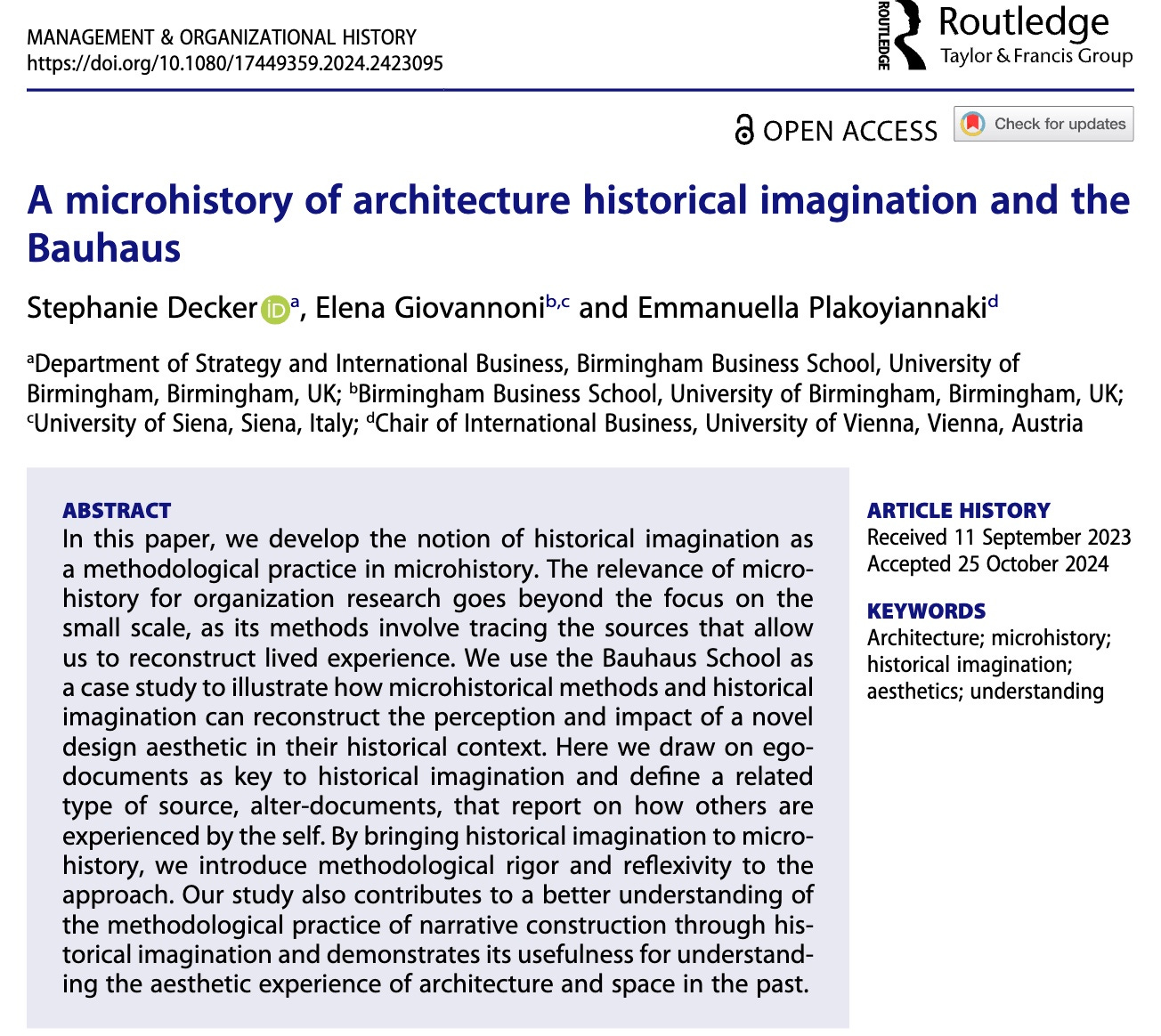
So use something that you wrote, recently enough that you remember it, which for me is this one:
Decker, Stephanie, Elena Giovannoni, and Emmanuella Plakoyiannaki. (2024) ‘A Microhistory of Architecture: Historical Imagination and the Bauhaus’. Management & Organizational History, advance online: https://www.tandfonline.com/doi/full/10.1080/17449359.2024.2423095.
LLMs as data extraction tools
First up, my perspective on AI, or more specifically LLMs, is that they are a data extraction tool. And as a qualitative researcher, ever time-poor and overloaded with too much to do and to read, I can see the value in expanding my reach through such tools.
