


This week’s roundup provides you with an early view of another history-themed call for papers for the EGOS conference 2027 in Liverpool, UK, on “The Past Through Games of Power”, alongside a free online qualitative research conference in May, hosted by Northeastern University, USA, and the Canadian Business History Association reading group in Toronto later this month.
Contents
The Past Through Games of Power: Memory and Organizational History,
Call for Papers, 43rd EGOS Colloquium in Liverpool, July 8–10, 2027
Northeastern Qualitative Research Conference (online)
Canadian Business History Association Reading Group, Toronto & hybrid, 24 April
The Past Through Games of Power: Memory and Organizational History
Call for Papers - 43rd EGOS Colloquium in Liverpool, July 8–10, 2027
Convenors:
Amon Barros, FGV EAESP, Brazil, amon.barros@fgv.br
Hamid Foroughi, Warwick Business School, University of Warwick, UK, h.foroughi@wbs.ac.uk
Gabrielle Durepos, Mount Saint Vincent University, Canada, gabrielle.durepos@msvu.ca
The sub-theme “Games of Memory and Power in Organizational History” invites analyses of how organizational actors use traces of the past as a resource to develop persuasive narratives and play political games in and around organizations (Suddaby, Israelsen, Bastien, et al., 2023). Interpretations of the past can be cultivated as memories that circulate within and across organizations (Coraiola et al., 2023) or as narratives that carry moral meanings and frame how actors interpret the past, present, and future (Hampel & Dalpiaz, 2023; Hernes & Schultz, 2020; Suddaby & Greenwood, 2005).
Interpretations of the past and the traces on which they rely are always situated in place and time and shaped by power relations (Durepos & Thurlow, 2025; Wanderley & Barros, 2019). Disputes over how the past should be interpreted can turn into conflicts over meanings within, where actors seek to impose meaning on the vastness of the past within the constraints of culture (Suddaby, Israelsen, Bastien, et al., 2023; Vaara & Whittle, 2022). Research on the uses of the past by organizational actors has established that narratives of continuity and rupture are the result of political disputes in which groups seek to establish belonging or exclusion through them (Foroughi, 2020).
Struggles about remembering and forgetting take many forms. From the meaning attributed to objects (Shortt & Izak, 2021), the design and uses of architectural spaces (Decker, 2014; Decker et al., 2024), and intentional narratives designed to narrate histories like corporate museums (Hatfield, 2024; Nissley & Casey, 2002), power games frame the past. Remembering and forgetting are situated outcomes from disputes, and even non-events and paths not taken continue to influence interpretations (Egholm, 2026). For instance, museums often naturalize the past or invite contestation of established meanings through strategies of display and narration (Aroles et al., 2024). The erasure of slavery from the management discipline is a paradigmatic case of forgetting (Cooke, 2003). Historiographical devices such as periodization (Sadeghi et al., 2024), turning points (Capoccia & Kelemen, 2007; Marquis & Qiao, 2024), and founding moments (Suddaby, Israelsen, Mitchell, et al., 2023) are not neutral. They result from choices that privilege actors, geographies, and causal stories while marginalizing others (Durepos & Thurlow, 2025; Durepos & Barros, 2023; Wanderley & Barros, 2019).
This stream invites studies that consider memory not as a repository but as a practice that gives meaning to the past through contested practices. It invites studies investigating the effects of power on remembering and forgetting (Casey & Olivera, 2011; Coraiola et al., 2023; Mena et al., 2016).
Submissions can explore this theme in various contexts. Below are some questions (not exhaustive):
How do power games within organizations use history to legitimize strategic agendas or delegitimize alternative interpretations, and with what consequences?
How do powerful actors shape which events become remembered, forgotten, or silenced in official organizational histories?
How do competing memories coexist, clash, or become reconciled in contexts where organizational histories are contested?
How can corporate museums, heritage initiatives, or even sites and objects become arenas for negotiating competing representations of the past?
How do historiographical devices (e.g., periodization, turning points, founding stories) become tools of power that privilege some voices and exclude others?
How do practices of forgetting—intentional or unintentional—serve political purposes within organizations?
How do actors strategically curate traces of the past to craft organizational identity, continuity, or rupture?
How do employees resist, reinterpret, or subvert dominant narratives about the organizational past?
How do transnational, postcolonial, or multi-sited organizations negotiate the politics of memory across different cultural or geographic contexts?
How do digital technologies and algorithmic curation reshape the politics of remembering and forgetting within organizations?
References
Aroles, J., Morrell, K., Granter, E., & Liang, Y. (2024). Representing, Re‑presenting, or Producing the Past? Memory Work amongst Museum Employees. Journal of Management Studies, joms.13059. https://doi.org/10.1111/joms.13059
Capoccia, G., & Kelemen, R. D. (2007). The Study of Critical Junctures: Theory, Narrative, and Counterfactuals in Historical Institutionalism. World Politics, 59(3), 341–369. https://doi.org/10.1017/S0043887100020852
Casey, A. J., & Olivera, F. (2011). Reflections on Organizational Memory and Forgetting. Journal of Management Inquiry, 20(3), 305–310. https://doi.org/10.1177/1056492611408264
Cooke, B. (2003). The Denial of Slavery in Management Studies. Journal of Management Studies, 40(8), 1895–1918. https://doi.org/10.1046/j.1467-6486.2003.00405.x
Coraiola, D. M., Foster, W. M., Mena, S., Foroughi, H., & Rintamäki, J. (2023). Ecologies of memories: Memory work within and between organizations and communities. Academy of Management Annals, 17(1), 373–404.
Decker, S. (2014). Solid intentions: An archival ethnography of corporate architecture and organizational remembering. Organization, 21(4), 514–542. https://doi.org/10.1177/1350508414527252
Decker, S., Giovannoni, E., & Plakoyiannaki, E. (2024). A microhistory of architecture historical imagination and the Bauhaus. Management & Organizational History, 1–25. https://doi.org/10.1080/17449359.2024.2423095
Durepos, G., & Barros, A. (2023). Haunted Houses: Addressing Archival Silences in Business (Hi)Storytelling (pp. 29–47). https://doi.org/10.1142/9789811273476_0002
Durepos, G., & Thurlow, A. (2025). Archival Research in Historical Organisation Studies: Theorizing Silences. Bingley: Emerald.
Egholm, L. (2026). Shadow futures: the persistence of past futures. Management & Organizational History, 21(1–2), 81–91.
Foroughi, H. (2020). Collective Memories as a Vehicle of Fantasy and Identification: Founding stories retold. Organization Studies, 41(10), 1347–1367. https://doi.org/10.1177/0170840619844286
Hampel, C. E., & Dalpiaz, E. (2023). Confronting the Contested Past: Sensemaking and Rhetorical History in the Reconstruction of Organizational Identity. Academy of Management Journal, 66(6), 1711–1740. https://doi.org/10.5465/amj.2020.1132
Hatfield, J. E. (2024). Branding public memory in the Walmart Museum. Memory Studies, 17506980241255075. https://doi.org/10.1177/17506980241255075
Hernes, T., & Schultz, M. (2020). Translating the Distant into the Present: How actors address distant past and future events through situated activity. Organization Theory, 1(1), 263178771990099. https://doi.org/10.1177/2631787719900999
Marquis, C., & Qiao, K. (2024). History Matters for Organizations: An Integrative Framework for Understanding Influences from the Past. Academy of Management Review, amr.2022.0238. https://doi.org/10.5465/amr.2022.0238
Mena, S., Rintamäki, J., Fleming, P., & Spicer, A. (2016). On the Forgetting of Corporate Irresponsibility. Academy of Management Review, 41(4), 720–738. https://doi.org/10.5465/amr.2014.0208
Nissley, N., & Casey, A. (2002). The politics of the exhibition: Viewing corporate museums through the paradigmatic lens of organizational memory. British Journal of Management, 13(S2), S35–S45.
Sadeghi, Y., Islam, G., & Van Lent, W. (2024). Practices of Periodization: Towards a Critical Perspective on Temporal Division in Organizations. Academy of Management Review, amr.2022.0396. https://doi.org/10.5465/amr.2022.0396
Shortt, H., & Izak, M. (2021). Scarred objects and time marks as memory anchors: The significance of scuffs and stains in organisational life. Human Relations, 74(10), 1688–1715. https://doi.org/10.1177/0018726720938848
Suddaby, R., & Greenwood, R. (2005). Rhetorical strategies of legitimacy. Administrative Science Quarterly, 50(1), 35–67. http://asq.sagepub.com/content/50/1/35.short
Suddaby, R., Israelsen, T., Bastien, F., Saylors, R., & Coraiola, D. (2023). Rhetorical History as Institutional Work. Journal of Management Studies, 60(1), 242–278. https://doi.org/10.1111/joms.12860
Suddaby, R., Israelsen, T., Mitchell, J. R., & Lim, D. S. K. (2023). Entrepreneurial Visions as Rhetorical History: A Diegetic Narrative Model of Stakeholder Enrollment. Academy of Management Review, 48(2), 220–243. https://doi.org/10.5465/amr.2020.0010
Vaara, E., & Whittle, A. (2022). Common Sense, New Sense or Non-Sense? A Critical Discursive Perspective on Power in Collective Sensemaking. Journal of Management Studies, 59(3), 755–781. https://doi.org/10.1111/joms.12783
Wanderley, S., & Barros, A. (2019). Decoloniality, geopolitics of knowledge and historic turn: Towards a Latin American agenda. Management & Organizational History, 14(1), 79–97. https://doi.org/10.1080/17449359.2018.1431551
Convenors’ short biographies
Amon Barros is an Associate Professor of Organization Studies at FGV EAESP (São Paulo, Brazil). His research focuses on the impacts of business on societies and on the history of management and organizations. He is co-editor-in-chief of Management and Organizational History and of Cadernos Ebape.BR. He is also an associate editor of Management Learning. His work has been published in the Academy of Management Learning and Education, Management Learning, Business History, Management and Organizational History, and Human Relations.
Hamid Foroughi is an Associate Professor in Responsible Management at Warwick Business School, University of Warwick (Warwick, United Kingdom). His research examines collective memory from political and strategic perspectives, exploring how organizational legacy and collective memory can serve as assets and investigating the politics of memory in relation to authenticity, inclusivity, and ethics. His work has been published in the Academy of Management Annals, Journal of Management Studies, Academy of Management Learning and Education, Organization Studies, and Journal of World Business.
Gabrielle Durepos is Professor of Organisation Studies at Mount Saint Vincent University (Halifax, Canada). She is co-author of ANTi-History: Theorizing the Past, History, and Historiography in Management and Organization Studies and Archival Research in Historical Organisation Studies: Theorising Silences. Her publications appear in Management & Organizational History, Journal of Management History, Business History, and Organization. She is co-editor-in-chief of Management & Organizational History.
And don’t forget the other history-themed track:
“All work and no play” - conceptions of work, organising and business in historical perspective

We are very pleased to announce that our sub-theme proposal for next year’s EGOS conference in Liverpool was accepted. We look forward to your submissions, and if you catch us at any conferences over the summer, feel free to ask us any questions you might have!
Northeastern Qualitative Research Conference registration open
Registration is now open for the 2026 Northeastern Qualitative Research Conference!
May 13th 10 AM – 1 PM EST: Virtual & Free
Register here: https://tinyurl.com/4c7a97rr
This year’s conference tackles two of the most pressing conversations in qualitative research:
Abduction in Qualitative Research
Transparency in the Age of AI
We have an incredible schedule:
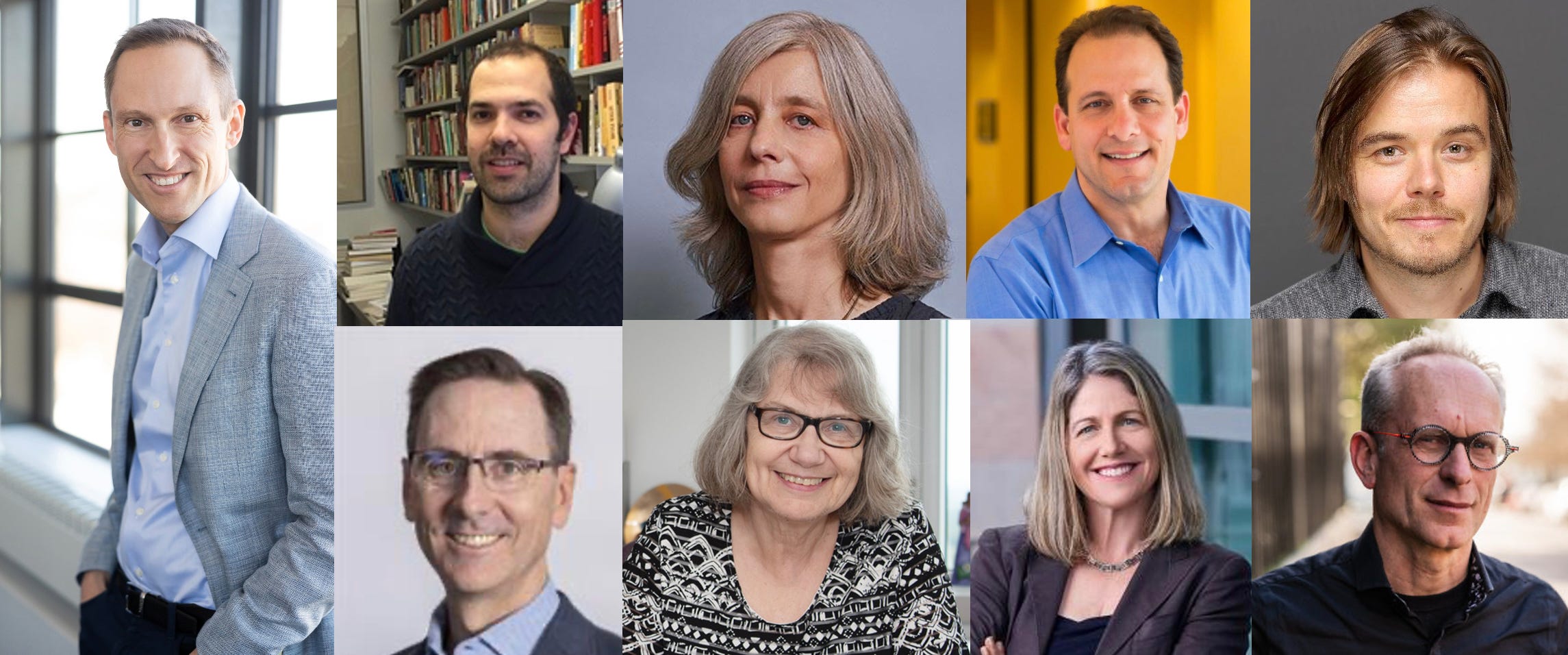
10:00: Introduction - Stine Grodal, Northeastern University
10:10: Abduction in Qualitative Research
• David Kirsch, University of Maryland
• Iddo Tavory, NYU
• Stefan Timmermans, UCLA
• Saku Mantere, McGill
11:30: Plenary by Ann Langley, HEC Montreal
11:50: Transparency in the Age of AI
• Lamar Pierce, Washington University
• Christine Beckman, UCSB
• Anne-Laure Fayard, Nova School of Business & Economics
• Kevin Corley, Imperial College London
12:50: Conclusion
Check out some of the videos from the past years here: https://www.youtube.com/@QualConference/videos
CBHA Reading Group
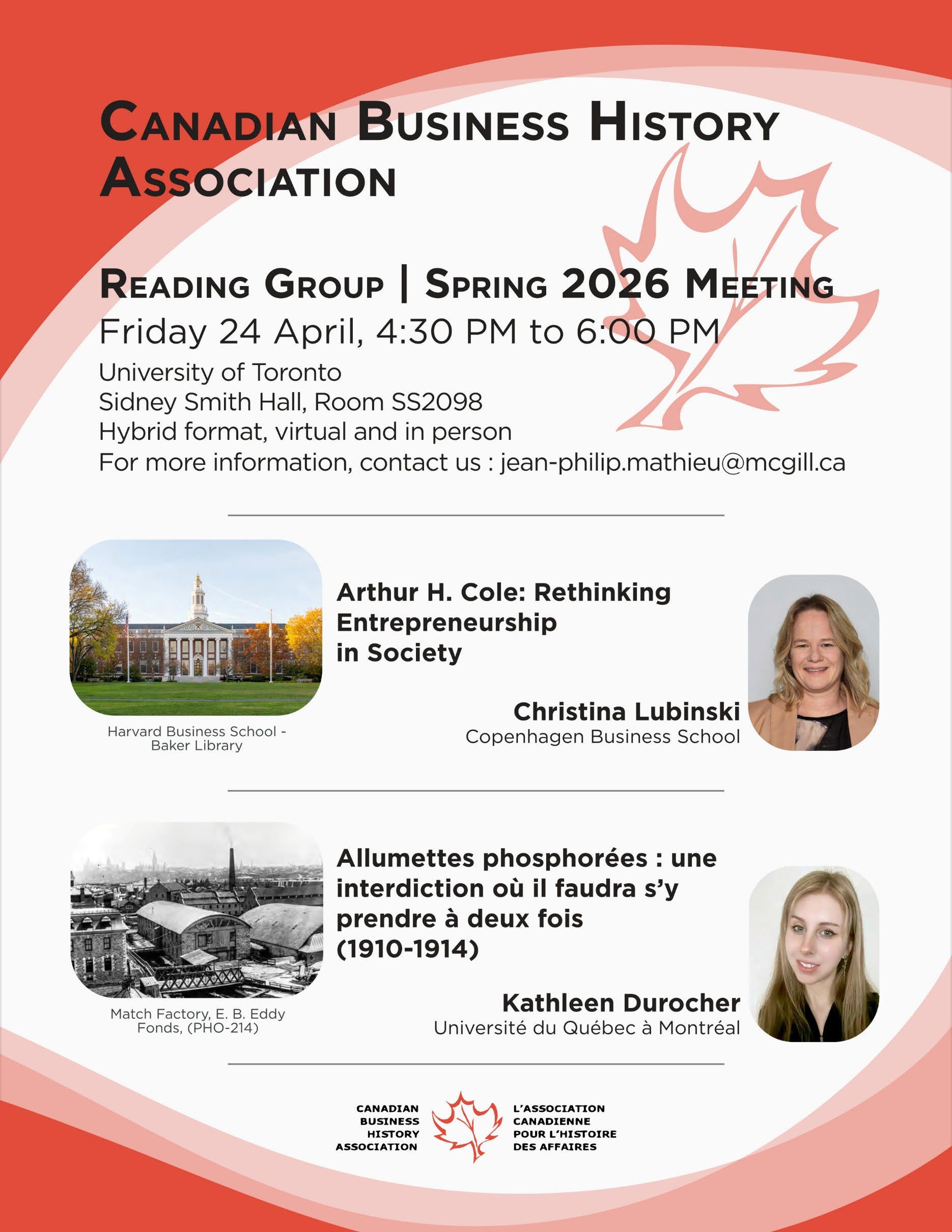
The Details:
24 April, 2026
4:30-6:00 pm
University of Toronto
Sidney Smith Hall Room SS2098
This session, we welcome Christina Lubinski (Copenhagen Business School) to discuss her recent work exploring Arthur H. Cole as a key architect of business and entrepreneurial history, showing how he built the field through an interdisciplinary research agenda, but also why his work never became canonical. It argues that Cole’s most lasting insights were to study entrepreneurship without heroic “great man” narratives and to explain it instead as a socially embedded process linking individual decision-making, institutional ecosystems, and public legitimacy.
We also welcome Kathleen Durocher (PhD candidate, Université du Québec à Montréal) to talk about a chapter from her dissertation regarding efforts to prohibit white phosphorus matches in Canada between 1910 and 1914, a campaign that was met by sometimes fierce opposition from industry and politicians. Ultimately, legislation was passed, a victory enabled by a shifting international context and lobbying by chemist Robert Fulford Ruttan, with support from the Royal Society of Canada. This chapter is in French and includes a detailed English summary. The discussion will be in English.
A hybrid option will be available for those unable to attend in-person.
Please contact jean-philip.mathieu@mcgill.ca to be added to the event mailing list and receive both papers.
Limited funding is available for PhD candidates who would like to travel to Toronto and whose research would benefit from participating in the reading group. Please email Jean-Philip for more information.
We look forward to seeing some of you there!