


Earlier this month, I had the pleasure of speaking on a panel about interdisciplinary research at the British Academy of Management Conference, specifically focusing on how management researchers can integrate historical methods into their work.
Historical methods can seem intimidating or "too different" from traditional management research methods, so my colleagues Emmanuella Plakoyiannaki and Mark Saunders discussed myths about historical research in IB, and how historical methods fit with wider qualitative research (respectively).
Historical research offers some really interesting opportunities for management scholars — but like many interdisciplinary endeavours, it comes with its own set of methodological choices and trade-offs that are worth understanding upfront.
The Methodological Landscape: More Than Just Archives
When most people hear "historical research," they seem to picture someone hunched over dusty documents in an archive (on behalf of archivists everywhere: a good archive is not dusty!). While archival work is certainly part of the historical toolkit, it's far from the whole story.
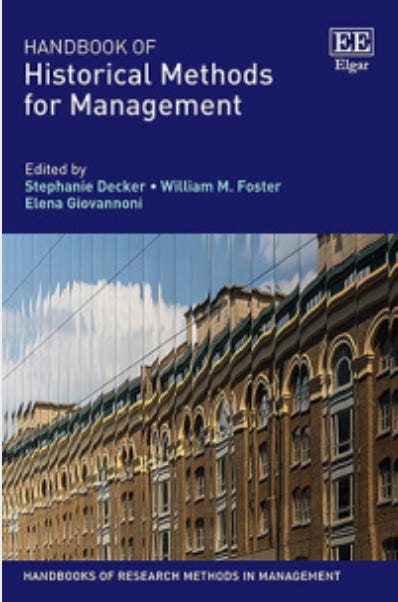
A few years ago, we published the Handbook of Historical Methods specifically for management researchers, partly to address this misconception. (The paperback and e-book versions are quite affordable; make sure you become an “Elgar member” to get a discount.) The handbook situates historical approaches within the qualitative research landscape in business and management.
And, as Mark pointed out in his talk, archival research has always been part of the many options of his famous "Research Onion".
What's particularly exciting is how historical approaches align with process studies. Think about it: how long would you need to follow a process through if you were observing it directly? Months? Years? Historical research offers a way to lengthen the processes you're examining in a more time-efficient manner, using the data traces that already exist.
Navigating the Terminology: Past vs History (Yes, They're Different)
One of the first hurdles when diving into historical research is the terminology. Historians have developed theoretical concepts that are not always familiar to management researchers, and understanding these distinctions helps with research design.
Take the difference between "the past" and "history." This might sound pedantic, but it's actually quite useful. Think Magritte: the picture of an apple is not the apple. Similarly, the history you read is never the past itself — it's one possible account of the data you have available. You're examining how well your narrative fits the data you hold.

This should sound familiar to qualitative researchers. We're always concerned with data-method fit, and historical research operates on similar principles.
Then there's "historiography" — essentially, historical theory that covers different approaches and methods. It's worth knowing about, but don't let it intimidate you.
History vs Memory: Different Lenses on the Past
Perhaps more important for management researchers is understanding the difference between history and memory as approaches to the past. Both are valuable, but they serve different purposes depending on your research question.
History is about archives, traces, and detective work. It's associated with learning through intellectual inquiry — you're trying to find out something you didn't know before. The past is distinct and separate; you need to make an effort to reconstruct it from the records and archives that provide access to something that's no longer directly observable.
Memory, on the other hand, is about what people carry from their past into the present. It's more emotional, more identity-focused. This is the past that's always present — sometimes traumatic, sometimes uplifting, often socially constructed through rituals and shared narratives. In organisational studies, you'll see plenty of work on rhetorical history, uses of the past, and memory in organisational settings.
Want to know more? The article this is based on is available open access in Human Relations.
The relationship between history and memory isn't either/or. You can do historical work that examines memory in the past, or use oral history approaches that reconstruct missing historical narratives through people's memories. The key is being explicit about how you're conceptualising the past within your broader research design.
Practical Approaches: Your Methodological Toolkit
Archival Methods: The Classic Approach
Archival methods involve looking at traces from the past, with heavy emphasis on verification and triangulation — skills that should feel familiar from other qualitative work. What's particularly valuable here is source analysis.
There's a great piece by Schaefer and Alvesson (2020) arguing that the critical attitude inherent in source analysis is relevant for all qualitative researchers, even when analysing interview transcripts. This critical approach forces you to ask: Who created this material? Who decided what goes in and what doesn't? What are they telling you, what aren't they telling you, and why?
These are questions we should always ask of our data, but source analysis makes this criticality systematic and rigorous.
Digital Sources: The Underexplored Goldmine
We have access to an enormous amount of digital source material in organisational studies, yet we see surprisingly few papers making use of it. The same critical attitude you'd apply to traditional archives is essential for digital materials: Who created this? Why did they put it online? What was their agenda?
Retrospective Methods: When Accuracy Isn't Everything
Sometimes accuracy isn't your primary concern. Sometimes the interesting question is: How are people telling this story from their current position? Retrospective methods offer different accounts that you can even juxtapose with archival material — the differences might tell you quite a lot.
This includes oral history collections that are often deposited in archives and publicly available. It's another form of data that's widely accessible but relatively underused in management research.
The Theorisation Challenge: It's Not Just You
Here's where many researchers get stuck. Most people doing historical research feel it's incredibly difficult to theorise from their findings. You spend ages explaining the historical context, and reviewers respond with: "Yeah, so what? How does this matter in terms of the theories we have?"
This challenge isn't unique to historical research — it happens with many alternative approaches. But there are some specific reasons why historical work faces particular hurdles:
The uniqueness problem: Reviewers sometimes argue that historical cases are "too unique" to generalise from.
Lack of templates: Unlike other methodological approaches, there aren't many clear templates for integrating historical evidence into management theory traditions.
Disciplinary tensions: Historians want detailed, nuanced accounts of unique events. Management theorists want parsimonious, generalisable insights. These requirements are contradictory.
The Theory Trade-Offs: You Can't Have It All
Recently, Andrew Carton (2025) published what might be the most insightful piece I've seen on this challenge. He argues that theory has three dimensions — generality, simplicity, and accuracy — and you can never do all three well simultaneously. At best, you can achieve two, and even that isn't easy.
This framework brilliantly captures what many interdisciplinary researchers come up against:
You can do something general and simple (high theory that journals love)
You can do something general and accurate (but it will be complex and hard to digest)
You can do something simple and accurate (actionable insights close to the phenomenon)
The key insight? If you want to do all three, you're probably looking at three different papers, not one. For interdisciplinary researchers, this framework helps explain why the work feels so challenging — and why the trade-offs are tricky.
Publication Strategies: Different Outlets, Different Contributions
If you're interested in historical research, you have multiple publication options, each with different expectations:
Management journals typically seek theoretical contributions with historical evidence, but prefer less detailed historical accounts.
Business history journals welcome empirical contributions that provide insights into the past, or historiographical pieces that present new explanations of past phenomena (Decker et al., 2024).
Interdisciplinary outlets might be interested in conceptual frameworks that help understand past phenomena, even if they require less historical detail.
The key is deciding which audience you want to speak to — just like any interdisciplinary work.
Making It Work: Practical Integration Strategies
Here's my practical advice for integrating historical research into your work:
Consider your audience first: Different outlets have different expectations. Match your approach accordingly.
Think beyond archives: Historical methodology isn't just about documents. The critical source analysis approach can enhance all your qualitative work.
Look for the historical element: Most organisational phenomena have historical dimensions. These can become additional papers or strengthen your main contribution.
Embrace the digital: We're underusing the wealth of naturally occurring digital data available to us. Historical methodology offers tools for approaching this material critically.
Accept the trade-offs: Interdisciplinary work always involves trade-offs. Understanding them upfront helps you make better strategic choices.
The Bottom Line
Historical research offers significant opportunities for management scholars, but like all interdisciplinary work, it requires navigating methodological choices and trade-offs. The key is understanding these challenges upfront rather than discovering them halfway through your project.
Whether you're looking to add historical depth to your process studies, explore organisational memory, or simply bring a more critical analytical approach to your qualitative work, historical methods have something to offer. The field is growing, the opportunities are there, and the methodological tools are becoming more accessible.
Most importantly, don't let the terminology or the perceived difficulty put you off. Like any methodological approach, it's learnable — and the insights it can provide are often worth the additional complexity.
If you found this useful, share it with your network!
Generality, simplicity, accuracy! Wish I'd thought of that. A simple yet elegant way of recognizing that you can't have it all. You must make choices & this post helps us understand the consequences of our choices. Well done.