


Recap
Last week I unpacked the “curse of knowledge”, which is just a neat explanation why it is so damn hard making your research or expertise accessible.
And all that effort is not exactly directly relevant to your career if you work in a research environment. While universities may claim that they keen for their academics to engage with the wider world “outside the ivory tower”, they don’t seem to know how to value it.
So why do it at all?
Catch-up service:
Have you seen the big discounts available still?
70% off on the Handbook of Historical Methods for Management
30% off the brand new Encyclopaedia of Historical Organization Studies
You can see more current perks for free and full subscribers on the Perks Page
Quick guide for new readers:
Looking for academic writing advice? Start here, but don’t forget to check out this piece on publication strategy, and this one if the QS matters in your institution.
Befuddled by AI? Teach it source criticism to stop hallucinations
Honestly, I find Substack and LinkedIn just feels like a far more generous environment, frankly. No battling endless peer review rounds, writing your article by (faceless) committee… At least nobody here will stop you from shouting into the void. The occasional annoying comment, but if you avoid Twitter, erm X, it’s alright.
Basically, it can be a nice balance.
But there are few things to consider if you want to do more than just shout into void and have as few readers as you do for the average academic article? First, it helps to understand how algorithms works. Next, we will look at "information gap theory” — the basic method by which clickbait gets you, but also a really good way to think about titles and openings that will convince readers in a really busy space to actually read what you write.
A short primer on algorithms
Everyone loves to hate an influencer. It has its moment, much like AI hatred. Since I’ve started playing around with this Substack and listening to a greater variety of podcasts, I have actually gained a whole new level of respect for people who make a living on the internet, selling their ideas, books, courses, knowledge or perspective.
That’s because of platform algorithms.
Each platform has their own. They are essential in not just attracting more followers to their platform, but also in their monetisation. How are platforms monetised?
You guessed right, by selling advertising.
Advertisers are sold a wider distribution to the right demographics, a “boost” in visibility.
“Boost” is a funny thing. Did you know that platforms intentionally “throttle” the organic reach of your post?
Plenty of online discussion especially about X/Twitter, but it also happens on LinkedIn — why do you think people do the “link in comments”? And if you have a page, rather than an individual account? Prime advertising target, most of your content will be throttled even harder.
So, say you have 4,000 followers on LinkedIn. Even your best post will only reach half of them (your standard one substantially less). Analytics now also show you the proportion inside and outside of your network, which is instructive.
Substack Notes I find better: toggle to “following” instead of “for you”, and you see posts from the people you follow. No endless scroll, either. If you curate tightly, you end up at yesterday’s already read posts.
But enshittification is real, so let’s enjoy it while it lasts.
Each platform tweaks their algo, and quite regularly, so internet lore about it abounds.
But all platforms have a pretty similar baseline: their algo will reward regular, engaged participants, who post and comment.
Bottom line: the odds that your brilliant write-up for a generalist audience will go viral on your first post are vanishingly small.
Academics on social media also love to treat it like it is a dissemination platform — their personal foghorn. Post and run.
Doing it properly
Let’s be honest: Doing social media properly as an academic is work. Work that we do not have time for, for which we do not get paid, on top of an already enormous invisible (and largely unpaid) workload of endless journals reviews and failed efforts.
(Don’t get me started on journal reviews: I seem to be doing one review a day, and they keep on coming.)
So here is my take: rather than try to engineer your AI to write your next paper for you, have your AI to write a user-friendly version for a wider audience for you. Give it good examples to work with, or provide it with some of the online guidance available.
You can even have it research the best strategies for you, and develop first drafts.
You are solely responsible for what your LLMs produces, so check it — any errors are yours, any crap you post is only going to affect your reputation. Claude don’t care. See how to ground it here.
I am not trying to dissuade you from actually learning how to write for a general audience which is a very different genre from academic writing. Realistically, though, even if we dedicated a huge amount of time (which we do not have) to learning how to write well for social media, the curse of knowledge means that we would likely still suck at it.
Yes, LLMs revert everything to a stylistic mean — which is no bad thing, given how awful much of academic prose truly is. Co-Pilot may be awful at writing for a 4* journal, but it might do just fine for LinkedIn. (Co-Pilot is probably the worst of the major AI-tools right now.) And with a spot of editing, you may not even sound too robotic (more on this in Part 3). There will be certainly less complicated words and shorter sentences, and you did not have to try.
Information gap theory
Sounds scientific but many of the formats in use on social media are based on this theory: you give some information, but open up a gap in understanding which makes readers curious. AIDA (Attention, Information, Desire, Action) is attributed to late 19th century marketeers. Worth noting that a marketing history colleague from Japan has researched this and thinks that may not be true.
But when academics are told to be accessible, academics strip the work down until nothing is left to think about. Because they are not told about the information gap theory at the same time. Research on curiosity suggests this loses the reader just as reliably. Celeste Kidd and Benjamin Hayden, reviewing the field in 2015, describe a consistent pattern: attention goes to material of middling difficulty.
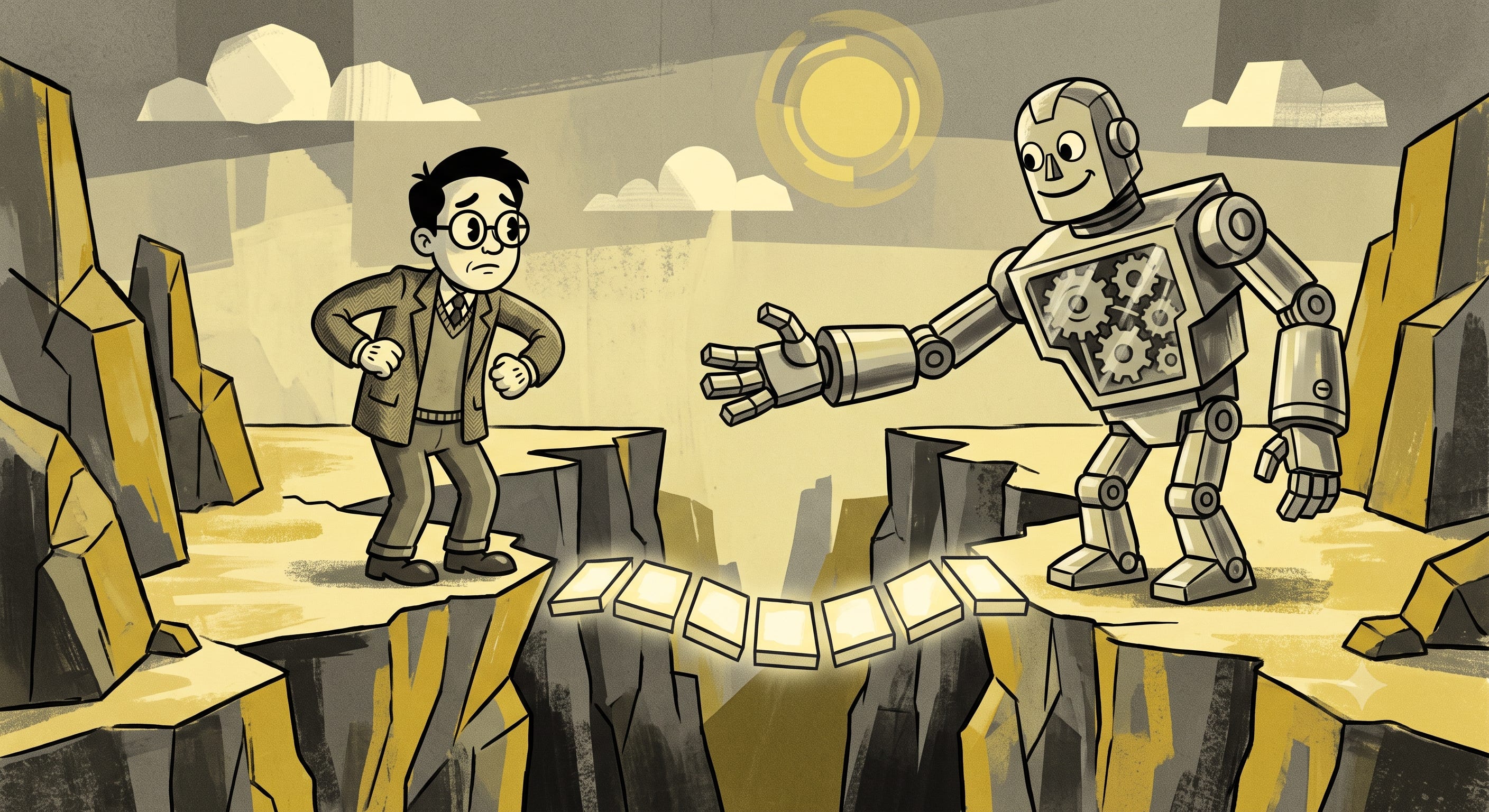
What is already obvious offers nothing worth attending to. What is too far outside the reader’s world offers nothing to hold on to. Both ends lose people.
Curiosity depends on knowing something already. You cannot feel a gap in a subject you know nothing about. So the reader needs enough footing to sense that something interesting is missing, and then they need it withheld long enough to want it.
The target is not simplicity. It is getting the pitch right.
And I bet you, your AI is better at that than you, because it has been trained on the whole of the internet, and then some.
Give it the right guidance and specificity, including some good guidance or practice provided by other people, and ask it to generate options for you.
Does the stuff the LLM produce still make sense? Honestly, you are the academic, you wasted endless hours of your life marking and reviewing other people’s work, just review the damn thing already. If you don’t know how, then who does?
And then just test whether it works better for you.
And if your handwritten stuff is better, more power (and also more work) to you.
By the end of this, you may write like the internet, too. Or, even better, you may find your own voice that had been drowned in academic jargon before.
Allegedly, we all go back to the ivory tower whence we came from, so what do we have to lose?
Part 3 will look at how you should edit any AI prose you like. What are the main tells, why are they a problem, and will they make your work look like slop (pro tip: yes, they will).
Can you make your AI write like you? (Yes, you can, and even if you don’t want that, having it analyse your own style can be quite instructive.) That, and more specific trips and resources can be found in the reserved section for full subscribers.
So that was the theory. Full subscribers get the practical set-up, too, with some helpful resources. Interested? You can always upgrade.
Too much, not everything relevant to your interests?
Manage which type of content you receive from History in Organizations:
Go to substack.com/settings (on the app: tap your profile picture, then Settings).
Under Subscriptions, click on History in Organizations.
You’ll see a toggle next to each section. Switch off the ones you don’t want. Grey means off. You can change your mind any time.
There’s a shortcut, too: the Unsubscribe link at the bottom of every email will offer to unsubscribe you from individual sections rather than the whole newsletter.
References
Iwamoto, A. (2023). The origin of AIDA: Who invented and formulated the AIDA model? Proceedings of the Conference on Historical Analysis and Research in Marketing, 21. https://ojs.library.carleton.ca/index.php/pcharm/article/view/4340/3310
Kidd, C., & Hayden, B. Y. (2015). The Psychology and Neuroscience of Curiosity. Neuron, 88(3), 449–460. https://doi.org/10.1016/j.neuron.2015.09.010