


In 2019, I photographed a poster on the wall of a restaurant in Dublin. It was for the Bauhaus Exhibition in Weimar in 1923. It ended up as Figure 1 in an article I wrote with Elena Giovannoni and Emmanuella Plakoyiannaki. Why was there a reproduction of that poster in a Dublin restaurant? I think it served the purpose of showcasing that this is a place of good taste and modern outlook.
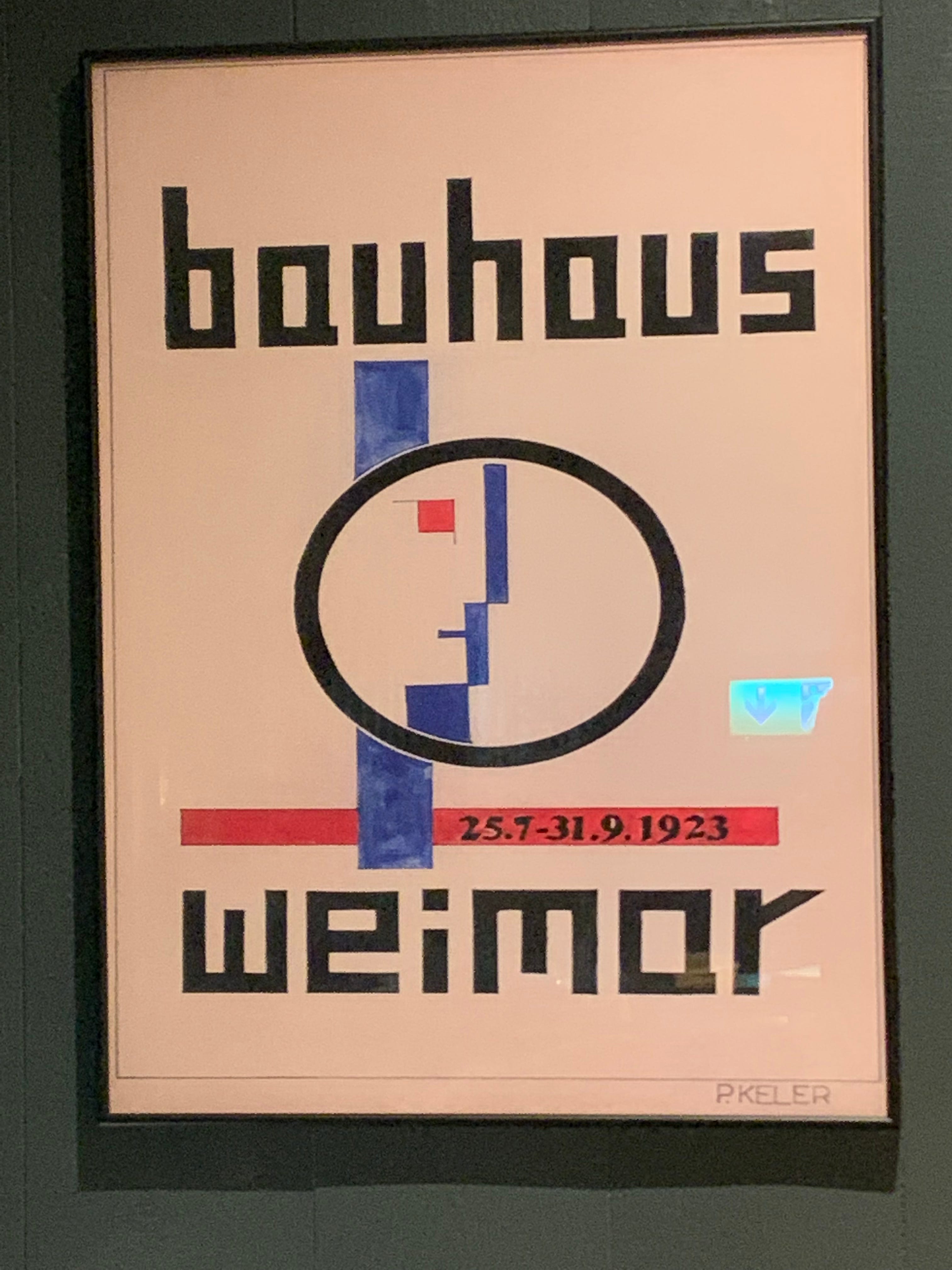
But how did the Bauhaus achieve this status of cultural signifier, and did people at the time, in 1923, view it in the same way? Unlikely.
What it was like to walk into the most significant part of the exhibition, the Haus am Horn, in the summer of 1923, and find a house with no hallway, rooms opening straight into other rooms, and a central skylight. Did that feel like the future, or like being informed that your own home was wrong?
Historians work mostly from documents, and also images. But these immediate experiences are never written down. People, of course, reflected on and wrote about the exhibition. Somewhat later. And those whose words found their way into newspapers were clearly elite voices. There was no social media then – though we all know that social media does not capture the immediacy of experience, as people avidly curate their public personas online.
So how can we research the historical experience of aesthetic innovations, of novelty, or realisation or new insights?
You may argue it is not relevant, but delight, wonder, shock and rejection are important for business and management research, too.
How people respond to innovations and how they engage with them matters directly, and often viscerally. Just think of the current backlash to AI data centres. Or Meta’s ultra-creepy glasses.
Understanding how things appeared in a different context is central to historical methods. While not as well-known and widely rehearsed as source criticism, there have been, admittedly somewhat disjointed, discussions of how historical researchers develop this understanding.
In a recent article, we outlined these practices as historical imagination. I will break down what that means in two posts. Today, we focus on the three practical steps you set out in the methods section, transparently linking your evidence to your interpretation. In the second part, we will focus on the standards that constrain historical imagination, differentiating historical narratives from novels and other forms of imaginative fiction. Yep, that is actually more straightforward than people claim.
Imagination has a bad name
Imagination is more often anathema to methods training sessions than a part of it. Research is supposed to be the opposite of it. Disciplined imagination may just about be allowed when it comes to theorising, according to the late Karl Weick.
Let’s challenge the organization theorists with one very influential historical theorist: R. G. Collingwood. His well-known book The Idea of History (1946) includes a chapter on the historical imagination. The thing you are researching does not exist anymore, which means you cannot observe it (like ethnographers), interview it (like social scientists), or run it a second time under different conditions (like an experimental researcher).
In management & organizational history, we have been over this – Gabie Durepos and co-authors have reframed this as the “ontological inaccessibility of the past”. Part of our working toolkit are key concepts like the past (everything that happened but can no longer be observed) and history (what we reconstruct about the past from traces of past occurrences).
But how do we reconstruct it? Collingwood, as a writer, likes visuals and metaphors, and he uses them to describe that historical narrative is “a web of imaginative construction stretched between certain fixed points provided by the statements of his authorities”.
And the fixed points are your sources. Authorities can also be historiography, but we get to this in part two. The web is provided by historical imagination.
E. H. Carr, another influential historical theorist, spoke more about the flesh on the bone, or the edible bit of a fruit, separate from the core.
Collingwood’s more famous comparison is the detective, who “is thinking exactly like an historian when, from indications of the most varied kinds, he constructs an imaginary picture of how a crime was committed, and by whom”. Carlo Ginzburg used the same idea decades later.
This is, of course, very engaging, and why I wanted to use a film noir gumshoe as a key character in “The Research Detective” series. Comparing historical practice to detectives at a crime scene has quite a long lineage.
That’s fun, but it won’t directly help you write your methods section. In our paper, we drew on Collingwood to develop three distinct steps that provide you with an auditable framework that helps your readers, who may not be historically trained, see how you interpreted your sources.
1. Interpolation: joining up what you already have
Small and simple: You have information that does not run continuously, it has gaps that are quite straightforward and you connect it.
Collingwood’s version: the sources put Caesar in Rome on one date and in Gaul on a later one, they say nothing whatever about the journey, “but we interpolate this with a perfectly good conscience”. Ours: in a business archive you find a letter sent by the managing director from Spain, and a later letter from the same person in Belgium. She travelled. A normal thing to do for someone in that position.
You may not say that she travelled by sea, that she enjoyed it, or that she stopped in Lyon on the way. (Unless you have evidence for any of this, of course.)
Most interpolation is quite mundane.
In the case of the Bauhaus, this seems not overly relevant, as the school is one of the most heavily documented organisations of the twentieth century. Still, as Trouillot has pointed out, it is simply impossible to record EVERYTHING. And the Bauhaus has been extensively documented as an artistic enterprise and as a school, in terms of its political battles and its key figures. As a business, not so much… other than that, we know it was not that commercially viable. Artists were interested in art, not accounting.
Most archival collections have gaps, even when they are very rich. Some are very, very “gappy”. It helps to be clear on that, and to outline how leaning on interpolation allows you to develop a preliminary narrative or outline of the case.
2. Interpretation: making the sources speak
Interpretation means assessing the plausibility of your evidence and putting people, their choices and the events they experienced back into their own time and context.
Take the 1923 exhibition. With hindsight it reads as the moment the Bauhaus arrived: the Haus am Horn, commissions from industry, thousands through the door, and the poster that ends up on a restaurant wall in Dublin ninety-six years later.
But what did the same event mean in its own moment?
After the paywall, how you use historiography to provide context, how understanding goes beyond interpretation, and some examples of the types of sources that really help you achieve this. Also, a curated list of interesting online reading and debate that are not rubbish (or botshit). ;-)
