

Newsround: Association of Business Historians Conference 2027 and Business History seeks new editor
The ABH Call for Papers is now out - Research monograph on organizations and fascism - University of Groningen Call for Papers - Apply to become editor of BH

Put these dates in the diary: the ABH will come to Brighton, UK, 16-18 June 2027. Below the CfP for the conference and the ever-popular Slaven Doctoral Colloquium. Have you completed your doctoral thesis in 2025 and 2026 in business history? Is it on a British subject or completed at a British university? Then you could submit your work for the long-running Coleman Prize — more information below. New books are coming fast at the moment — Klaus Meyer has published his historical research on the rise of the Nazi Party in Braunschweig, Germany. The University of Groningen, Netherlands, will host a two-day workshop in October “Between local and global”, on the financial and business history of the low countries. Also, Business History is searching for a new editor — could it be you?
Contents
ABH 2027 CfP, Slaven Colloquium & Coleman Prize
Encyclopaedia of Historical Organization Studies
CfP for financial & business history of the Low Countries workshop at the University of Groningen
Business History seeks new editor
1. Call For Papers: Association of Business Historians Conference 2027
The University of Sussex, Brighton, UK.
16th to 18th June 2027
Work, Leisure and Wellbeing
The Association of Business Historians Conference 2027 will be held at the University of Sussex, located in Brighton, UK from 16th to 18th June 2027. The Association invites submissions to the conference committee on all areas of business history as well as on the conference theme of ‘Work, Leisure and Wellbeing’.

Business History’s central concern is the behaviour of the firm, organisations, and entrepreneurs, in their context and overtime. This is inherently linked to the work that people do and how they do it. This can be the strategy work done by senior managers. It can be the structures devised by managers for the planning and coordination of the organisation of work. Or it can be questions about where certain activities, such as research and development, sales and marketing, or manufacturing, have been located: within countries or, in different countries by multinational enterprises. For entrepreneurs the question of what works, what will work, and what does not work, not only shapes markets, and industries, but leads to the emergence of new ones. We might also reflect on the work that we, as business historians, do, and how we do it – and, how this compares to other historical or management disciplines
Leisure might well be thought of as the distinct opposite of work… but is it quite so simple? The growth of holiday resorts, and spa towns (which are sites of work) have been linked to greater disposable time and income. Leisure destinations have also been related historically to increasing awareness for the protection and maintenance of health, and for the increasing propensity for conspicuous consumption and display of wealth (Walton, 2014). In some instances, this has given rise to the creation of new business opportunities, the emergence of leisure-based industries (Parsons and Rose, 2004) and the rise of new tourist destinations and categories of tourism (Jones and Spadafora, 2017). Further, recent scholarship has explored the growth of sport and leisure activities in industrial and urban contexts (Gillet, 2019). Yet with the rise of new locations for tourism, traditional sea-side resorts, much like old industrial and manufacturing districts, can become “left behind.” This may raise interesting questions about the role of businesses and entrepreneurs in economic regeneration of such places. The conference location in Brighton, is an excellent space to reflect on these issues, and how we think about leisure as a business.
Finally, focusing on work and leisure enables us to we consider the concept and importance of wellbeing and health; its historical manifestations, as well as its commercialisation. While health and the health industries underwent a deep transformation in the twentieth century, our understanding of health has changed and evolved over the course of history; and continues to develop (Donzé and Fernández Pérez, 2019). This is applicable not just to physical health but also to a broader awareness of wellbeing: encompassing mental, social and even environmental health. Exploring the connections of organisations and entrepreneurs to these topics can ultimately help improve our knowledge of the workings of business and the economy over time.
We invite participants who are considering the conference theme to address these and related themes, but the conference committee is looking to develop a diverse programme for the conference and welcomes all papers and panels on any aspect of business history.
References
Donzé, P. Y., & Fernández Pérez, P. (2019). Health Industries in the Twentieth Century. Business History, 61(3), 385–403.
Gillett, A. G. (2019) ‘Sport in Urban England: Middlesbrough, 1870–1914’, Business History, 61(2), pp. 380–381
Jones, G. and Spadafora, A. (2017) ‘Creating Ecotourism in Costa Rica, 1970-2000’, Enterprise & Society, 18(1), pp. 146–183.
Parsons, M. C. and Rose, M. B. (2004) ‘Communities of Knowledge: Entrepreneurship, Innovation and Networks in the British Outdoor Trade, 1960–90’, Business History, 46(4), pp. 609–639.
Walton, J. K. (2014) ‘Family firm, health resort and industrial colony: The grand hotel and mineral springs at Mondariz Balneario, Spain, 1873–1932’, Business History, 56(7), pp. 1037–1056.
How to submit a paper or session proposal
The programme committee will consider both individual papers and proposals for entire panels. We are keen to encourage both developmental and more mature papers. Individual paper proposals should include a one-page (up to 300-word) abstract with title of the presentation and brief biographical note. Panel proposals should include a cover letter stating the title and rationale for the panel and the name of its contact person; one-page (300-word) abstract and author’s CV for each paper; and a list of preferred panel chairs and commentators with contact information. The deadline for submissions is 29th January 2027.
The ABH Conference organiser is Dr Tom Buckley.
The Program Committee intend to send notifications of acceptance as soon as possible once the deadline has passed.
All questions and queries regarding the conference should be directed to Tom Buckley at ABH@sussex.ac.uk
The University of Sussex, founded in 1961, has a rich tradition of interdisciplinary research looking at problems that need a different perspective, across different periods of times. The University of Sussex Business School (https://www.sussex.ac.uk/business-school/) grew out of the founding departments of economics and the science policy research unit. The campus is located on the edges of the South Downs National Park, conveniently located close to Brighton, a creative seaside city known for its welcoming and inclusive culture.
---
Poster submissions
The conference a welcomes poster proposals from graduate students on all aspects of business history.
Poster presenters will normally be in either the First or Second Year of their PhD and are ideal for those students who are presenting work at the Tony Slaven Doctoral Workshop to showcase their research to the wider conference audience. Please note you need to apply for the poster session and the Tony Slaven Workshop separately.
Those wishing to be considered for inclusion in the programme must submit an application to Dr Tom Buckley (ABH@sussex.ac.uk) by 26th March 2027. This should provide:
Title of your PhD project.
An abstract (300 words) that explains the background to the poster; the questions addressed; the sources and methods employed; and likely conclusions.
A current CV.
Approved posters must be submitted by 1st June 2027, and a style guide will be circulated to all presenters selected for poster presentations.
Approved posters must be submitted by 1st June 2027. A style guide will be circulated to all presenters selected for poster presentations.
---
Call for Tony Slaven Doctoral Workshop in Business History, 16th June 2027
The ABH will hold its fourteenth annual Tony Slaven Doctoral Workshop on 16th June 2027. This event immediately precedes the ABH Conference and will take place at the University of Sussex Business School. Participants in the Workshop are encouraged to attend the ABH Conference following the Workshop. They will also have an opportunity to participate in the presenting their research in the Conference Posters (explained in the main call for papers). The Workshop is an excellent opportunity for doctoral students to discuss their work with other research students and established academics in business history in an informal and supportive environment. Students at any stage of their doctoral studies, whether in their first year or very close to submitting, are urged to apply. The workshop provides new researchers with an opportunity to discuss their work with experienced researchers in the discipline and also includes professional development sessions. The Workshop interprets the term ‘business history’ broadly, and it is intended that students in areas such as (but not confined to) the history of management and organizations, international trade and investment, financial or economic history, agricultural history, the history of not-for- profit organisations, government-industry relations, accounting history, social studies of technology, and historians or management or labour will find it useful. Students undertaking topics with a significant business history element but in disciplines other than economic or business history are also welcome. We embrace students researching any era or region of history.
Each student delivers a 15-minute presentation that is either (depending on how developed your project is) a summary of your PhD prospectus giving an overview of the overarching themes, research questions, and methodologies, or a specific chapter/paper. Time is devoted for discussion of each student’s work and the opportunity to gain feedback from active researchers in the field.
How to Apply for the Tony Slaven Workshop
Your application should be no more than 4 pages sent together in a single computer file: 1) a one-page CV; 2) one page stating the name(s) of the student’s supervisor(s), the title of the theses (a proposed title is fine), the university and department where the student is registered and the date of commencement of thesis registration; 3) an abstract of the work to be presented.
You may ask questions and apply via email to the Workshop organiser Dr Ian Jones at ian.g.jones@sheffield.ac.uk. Please use the subject line ‘Tony Slaven Workshop’ and submit by 26th March 2027.
---
Coleman Prize 2027
The ABH is pleased to announce that the 2027 Coleman Prize is open to PhD dissertations in Business History (broadly defined) having either a British subject or completed at a British university. All dissertations completed in the previous two calendar years (2025 and 2026) are eligible. In keeping with the ABH’s broad understanding of business history, applications are strongly encouraged from candidates in economic history, social history, labour history, intellectual history, cultural history, environmental history, the history of science and technology, the history of medicine, or any other subfield.
To apply for the Coleman Prize, supervisors are encouraged to nominate recent PhDs. Self-nominations are also strongly welcomed. Please send a PDF including the title of your PhD dissertation and a brief abstract (up to 2 double-spaced pages) to Dr Zane Jennings at zane.jennings@sas.ac.uk by 19th February 2027. The abstract should make clear the dissertation’s contribution to business history. Longlisted candidates will be requested to submit electronic copies of their dissertations 19th March 2027. Finalists will be notified by 7th May 2027. It is a condition of eligibility for the Prize that finalists will present their findings in-person at the Association’s annual conference. A full list of past winners can be found here, along with a series of podcasts with some of the past winners talking about their research: https://www.theabh.org/previous-winners
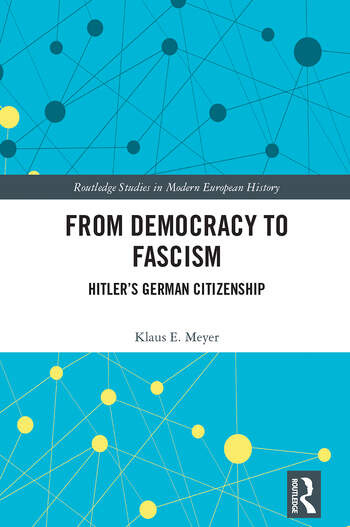
2. From Democracy to Fascism: Hitler’s German Citizenship
How did a democratic society turn fascist? This book explores the political dynamics of the Free State of Braunschweig from 1930 to 1933 surrounding Adolf Hitler’s appointment to civil service – a decision enabled by the traditional conservative parties that paved his path to German citizenship.
Prof Klaus Meyer, a well-known scholar in international business, has long been interested in history, and this is his first historical monograph (though by no means his first book). Focusing on the city of Braunschweig, his research carefully unpacks the political and organizational maneuvring that lead to the nationalsocialists building community support and coalitions with existing elites.
3. Call for Papers: Between local and global — Financial and business history of the Low Countries in an interconnected world
University of Groningen, 8 – 9 October 2026
Workshop theme
The Low Countries have long occupied a distinctive position in the history of global finance and international business. For centuries, the Netherlands and Belgium sat at the centre of international capital markets, trade networks and monetary systems, while businesses and financial institutions based in the Low Countries played an important role in connecting local economies to global markets, colonial territories and international production networks. At the same time, these globally connected economies continued to rely on local institutions to manage the pressures and shocks that openness brought. The tension between local embeddedness and global entanglement is not merely a historical curiosity. In a period of renewed geopolitical uncertainty, fragmenting trade relations and debate about the costs of economic interdependence, history offers a genuinely useful vantage point.
The Financial, Economic and Business History (FEBHIS) group at the University of Groningen invites submissions for a two-day workshop on the financial and business history of the Low Countries, to be held in Groningen on 8–9 October 2026. The workshop is open equally to all economic, social, financial and business historians, as well as scholars in related fields.
We welcome papers on the financial and business history of the Low Countries, broadly understood to include the Netherlands, Belgium, Luxembourg, their predecessor polities and their overseas possessions, across all time periods. We also welcome comparative contributions and papers on other geographical settings that speak to the workshop theme. We particularly encourage submissions that engage with the interplay between local institutions and global dynamics.
Topics may include, but are not limited to:
• The role of international financial centres
• Multinational enterprises, international business and corporate expansion
• Trade, shipping, commodities and international production networks
• Monetary integration and disintegration
• Cross-border capital flows and their domestic consequences
• The financial and business dimensions of empire and decolonisation
• The resilience of local businesses and financial institutions in the face of external shocks
• Public finance, state formation and business-government relations
• Banking, credit and financial intermediation
The workshop will run over two days. The first day is dedicated primarily to early-career researchers and is intended to provide PhD students and postdoctoral scholars with a supportive environment in which to present and discuss work in progress. Senior scholars are warmly invited to attend and contribute constructively to the discussion. The second day will feature a broader research programme open to scholars at all career stages.
Presenters are expected to share work that has not yet been accepted for publication in a peer-reviewed journal. The workshop is intended not only to foster discussion, but also to encourage the development of research with the potential to lead to publication in leading journals and to stimulate future conference sessions and collaborative initiatives in economic, business and financial history.
Submission details
Please send an abstract of no more than 300 words, together with a brief biographical note of no more than 100 words, to febhis@rug.nl by 31 August 2026. Please indicate in your submission whether you are an early-career researcher and whether you wish to be considered for a travel bursary. Decisions will be communicated by 7 September 2026. There is no registration fee for participation in the workshop.
Submission deadline: 31 August 2026
Notification of decisions: 7 September 2026
Workshop dates: 8-9 October 2026
Location: University of Groningen, Groningen, the Netherlands
Organisers: Amaury de Vicq (a.devicq@rug.nl) and Abe de Jong (abe.de.jong@rug.nl)
Enquiries: febhis@rug.nl
4. Applications are invited for an Associate Editor to join the Editorial Team for Business History
The positions are for terms of up to four years in the first instance, starting in September 2026, renewable by mutual consent for further terms at Routledge’s discretion.
About the Journal
Business History is an international journal concerned with how businesses, organizations, and their environment develop over time, and how this influences contemporary organizations. It publishes interdisciplinary articles that contribute new insights into the past activities of organizations and their major stakeholders. Research in business history makes (1) empirical contributions by presenting new historical sources, which may be archival, visual or material, as well as oral history; (2) historiographic contributions, by engaging with research controversies in the field of business history, building new conceptual frameworks for understanding business or organizational activity in the past; or challenge existing conceptual frameworks that have shaped our understanding of the past; (3) theoretical contributions by using historical research to contribute to relevant social science and organizational theories by drawing on the past as an empirical setting. Business History continues to widen and deepen its international scope by promoting research on under-researched regions, time periods and topics.
All research articles in this journal are rigorously peer reviewed, based on initial editor screening and anonymized reviewing by at least two referees.
The Journal is indexed in the Social Science Citation Index (SSCI), Scopus and numerous business journal quality lists, such as the CABS and ABDC lists. Please visit www.tandfonline.com/fbsh for additional information about the Journal and Publisher.
Job Description
We are seeking an Associate Editor to drive the strategy for Business History, working to enhance the impact and reputation of the Journal. The Associate Editor will manage the peer review process for papers assigned to them, recommending high quality papers to publish. Routledge provide an annual contribution to expenses incurred by the Editorial team.
Key Tasks
The tasks to be undertaken will include but will not be limited to:
● Working with the Editorial Team, Routledge and the Editorial Board to develop the editorial strategy and direction of Business History and acting as an ambassador for the Journal;
● Day-to-day manuscript and peer review management including selecting and managing peer reviewers and making recommendations for the final decision on papers assigned to you;
● Ensuring that all reviewers and authors uphold the Journal’s code of publishing ethics;
● Attendance and networking at international conferences and events to promote Business History and solicit submissions, invited contributions, and special issue proposals;
● Responsibility for enhancing the quality and reputation of Business History, particularly in relation to the quantity, quality and timeliness of published research;
● Commissioning topical special issues with active, well-respected Guest Editors;
● Working with the Editorial Team to refresh the Editorial Board and pool of reviewers as necessary in terms of subject specialisms and geographical representation;
● Attending Editorial Team / Editorial Board meetings during the year (typically quarterly).
Candidate Experience
We are seeking one outstanding and professional academic who is actively involved in the disciplines covered by Business History, with an international reputation for research excellence, and a passion for communication. We particularly encourage applications from business historians who have engaged deeply in the business history community. A history of submitting to and reviewing for business historical journals is essential. Prior experience of editing in an established journal is preferred, but not essential.
Applicants should be actively involved in networks within the field. Key qualities sought for the positions include energy, enthusiasm, managerial skills to oversee the editorial cycle, an understanding of research and publishing ethics, and the ability to meet deadlines and work effectively with Editorial Team members and a major publisher. The term of service will be four years in the first instance, renewable for two year periods thereafter.
Application Procedure
Applications must include a letter of interest, specifically referring to why you believe you are particularly qualified for the role of Associate Editor as part of an Editorial Team for Business History, and how you see your role in the future development and direction of the Journal (maximum of 1 side of A4). CVs should also be submitted.
To submit your application, or for further details, please contact:
• Niall G MacKenzie, Editor-in-Chief, Business History, niall.mackenzie@strath.ac.uk
• Christina Lubinski, Editor-in-Chief, Business History, cl.bhl@cbs.dk
• Vicki Whittaker Head of Portfolio for Business, Management & Economics Journals, Routledge, Taylor and Francis Group, Vicki.Whittaker@tandf.co.uk
Anyone who wishes to discuss this position informally with the Executive Editors are welcome to contact Niall MacKenzie or Christina Lubinski at the email addresses given above.
The deadline for applications is 1st September 2026
Candidates who pass the initial screening stage may be invited for an interview with the Executive Editors and Routledge, over video link.
All applications will be treated as strictly confidential. Routledge will judge each on its merits without regard to the race, religion, nationality, sex, seniority, or institutional affiliation of the candidate.