


Contents
Free book on academic careers
EGOS 2026: historical sub-themes
New Scholars: Forthcoming webinars, including AI and qualitative data analysis
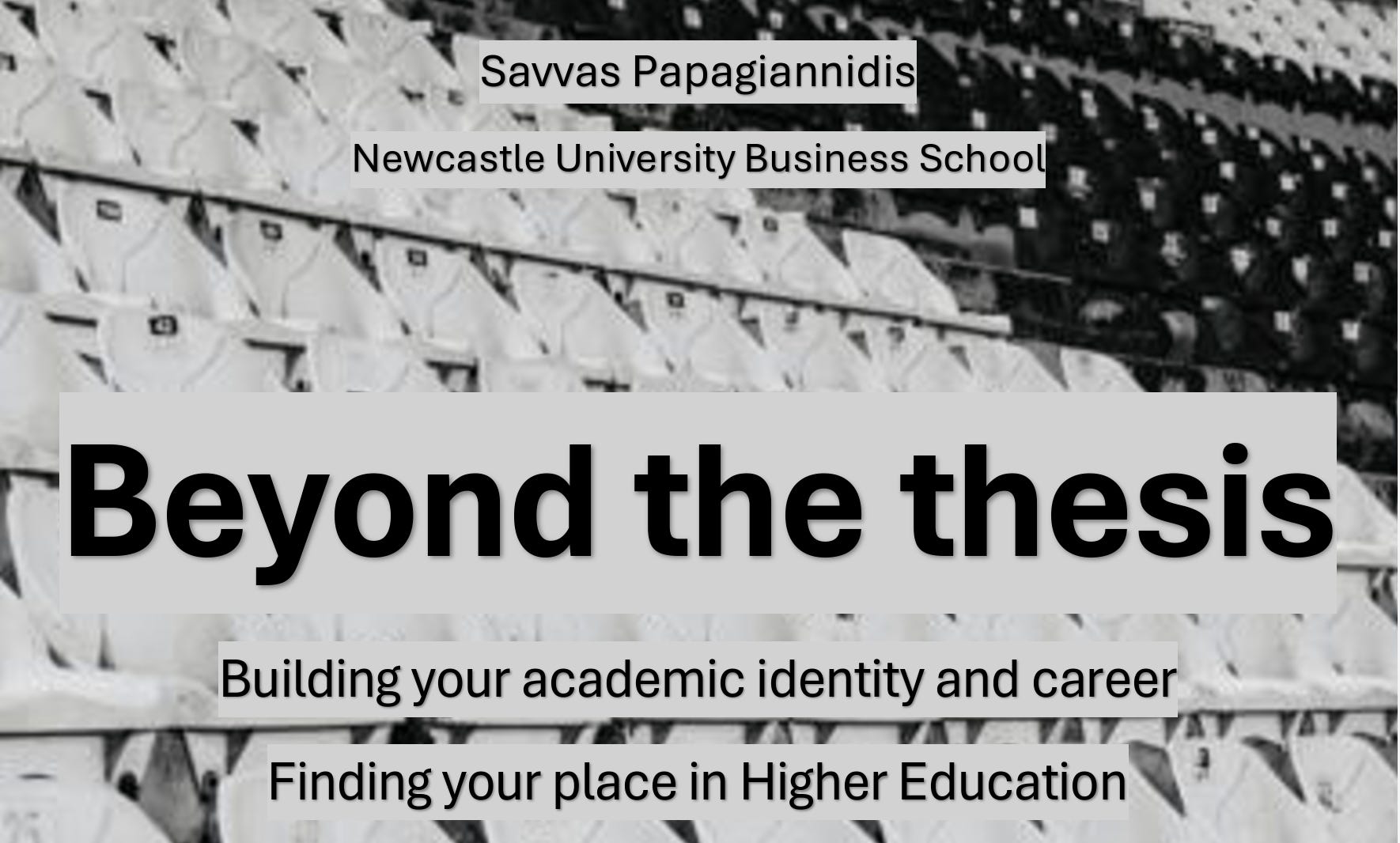
1. Free book: Beyond the thesis (Savvas Pappagianidis)
Beyond the Thesis: Building Your Academic Identity and Career is a practical and reflective guide for doctoral researchers and early-career academics making the transition from PhD study into professional life. It argues that a doctorate is not simply an end point or qualification, but the beginning of a longer professional journey in which identity, relationships, skills and reputation are already being formed. The book explores career planning under uncertainty, professional identity, first academic jobs, applications and interviews, mentoring and networking, teaching, research, leadership, engagement and sustainable working practices. Combining honest reflections on mistakes with practical actions, it helps readers make more deliberate and informed choices about the kind of academic or wider professional life they want to build.
2. EGOS 2026 Liverpool: Historical sub-themes
Sub-theme 14: [SWG] Qualitative Restudies: Retheorizing in a Changing World
Convenors:
Tine Köhler, University of Melbourne, Australia, tkoehler@unimelb.edu.au
Catherine L Welch, Trinity College Dublin, Ireland, welchc@tcd.ie
Maria Rumyantseva, University of Sydney, Australia, maria.rumyantseva@sydney.edu.au
Call for Papers
The purpose of this sub-theme is to stimulate research and theorizing from qualitative work, diversifying the theorizing potential of qualitative research methods in our field. More specifically, with this sub-theme, we aim to inspire the community of organization scholars to advance our knowledge of modern organizations by realizing the potential of qualitative restudies for retheorizing.
A restudy is an empirical study which is designed to enable systematic comparison with the original data, analytical results, or field setting of a prior study. Restudies could extend the original theorizing, reconstruct it in meaningful ways, refute existing theories, or add new lenses and theoretical perspectives.
In returning to original studies and their empirical sites, qualitative restudies allow organization scholars to explore how our interpretations and theorizing are shaped by theoretical and methodological traditions, historical contexts, institutional structures, and researcher backgrounds. By acknowledging the situatedness of inquiry, restudies pave the way for more critical and sustained engagement with phenomena of interest, the populations and contexts in which we explore them, and the theoretical legacy on which we build our work (Köhler et al., 2025; Rumyantseva & Welch, 2023). They are the basis for retheorizing; that is, for conducting studies that return to existing empirical work in order to reevaluate the theoretical conclusions generated.
Sub-theme 62: “All Work and No Play” - Conceptions of Work, Organizing and Business in Historical Perspective
Convenors:
Nicholas D. Wong, Newcastle Business School, UK, nicholas.d.wong@northumbria.ac.uk
Stephanie Decker, University of Birmingham, UK, s.decker@bham.ac.uk
Valeria Giacomin, Bocconi University, Italy, valeria.giacomin@unibocconi.it
Call for Papers
This sub-theme examines how boundaries between work and play have been historically constructed, challenged, and transformed within organizational life. While current debates focus on issues like gamification, work-life balance, and the playfulness of digital capitalism, we contend that these trends are rooted in deeper historical tensions that remain insufficiently explored. By contextualizing how people in organizations have understood, policed, celebrated, or worried about the relationship between work and play, we uncover the contingent assumptions that continue to influence modern organizations.
The sub-theme title invokes both folk wisdom (“all work and no play makes Jack a dull boy”) and historical ideologies that sought to eliminate playfulness from “serious” business. This deliberate ambiguity reflects our interest in the tensions, contradictions, and struggles that have characterized the work-play relationship across time. This sub-theme will address several core issues, including: How have organizations attempted to harness, regulate, or eliminate playful practices? What forms of resistance, creativity, and subversion have emerged through workplace play? And how have shifting conceptions of human nature, from Johan Huizinga’s homo ludens (the playful human) to the dominant model of homo economicus, influenced organizational forms and management practices over time? How did sectors focused on innovation or creative products engage with the paradoxical tensions between “work” and “play”? How have entrepreneurs in creative and cultural industries developed business models to monetize “play” to form a profit-making enterprise? Ultimately, the sub-theme will explore how historical analyses contribute to the business and organization of play.
Sub-theme 70: The Past Through Games of Power: Memory and Organizational History
Convenors:
Amon Barros, FGV EAESP, Brazil, amon.barros@fgv.br
Hamid Foroughi, University of Warwick, UK, hamid.foroughi@wbs.ac.uk
Gabrielle Durepos, Mount Saint Vincent University, Canada, gabrielle.durepos@msvu.ca
Call for Papers
The sub-theme “Games of Memory and Power in Organizational History” invites analyses of how organizational actors use traces of the past as a resource to develop persuasive narratives and play political games in and around organizations (Suddaby et al., 2023). Interpretations of the past can be cultivated as memories that circulate within and across organizations (Coraiola et al., 2023) or as narratives that carry moral meanings and frame how actors interpret the past, present, and future (Hampel & Dalpiaz, 2023; Hernes & Schultz, 2020; Suddaby & Greenwood, 2005).
Interpretations of the past and the traces on which they rely are always situated in place and time and shaped by power relations (Durepos & Thurlow, 2025; Wanderley & Barros, 2019). Disputes over how the past should be interpreted can turn into conflicts over meanings within, where actors seek to impose meaning on the vastness of the past within the constraints of culture (Suddaby et al., 2023; Vaara & Whittle, 2022). Research on the uses of the past by organizational actors has established that narratives of continuity and rupture are the result of political disputes in which groups seek to establish belonging or exclusion through them (Foroughi, 2020).
Struggles about remembering and forgetting take many forms. From the meaning attributed to objects (Shortt & Izak, 2021), the design and uses of architectural spaces (Decker, 2014; Decker et al., 2024), and intentional narratives designed to narrate histories like corporate museums (Hatfield, 2024; Nissley & Casey, 2002), power games frame the past. Remembering and forgetting are situated outcomes from disputes, and even nonevents and paths not taken continue to influence interpretations (Egholm, 2026). For instance, museums often naturalize the past or invite contestation of established meanings through strategies of display and narration (Aroles et al., 2024). The erasure of slavery from the management discipline is a paradigmatic case of forgetting (Cooke, 2003). Historiographical devices such as periodization (Sadeghi et al., 2024), turning points (Capoccia & Kelemen, 2007; Marquis & Qiao, 2024), and founding moments (Suddaby et al., 2023) are not neutral. They result from choices that privilege actors, geographies, and causal stories while marginalizing others (Durepos & Barros, 2023; Durepos & Thurlow, 2025; Wanderley & Barros, 2019).
3. New Scholars resources
New Scholars offers resources to help management researchers advance meaningful and rigorous scholarship. Watch over 100 webinars on YouTube and join our LinkedIn group.
Click on the session titles below to learn about each webinar and register.
Webinars
AI for Better Qualitative Research: From concerns to good practices
Henri Schildt
September 23
Designing Research for Fit: Research design considerations for qualitative researchers
Charlotte Cloutier | Kevin Corley | Ann Langley
October 20
You’ve Got Data – Now What? Analyzing qualitative data for insight and impact
Charlotte Cloutier | Kevin Corley | Ann Langley
November 24
Developing Management Scholarship in the Age of Generative AI
Beth Bechky | Joep Cornelissen | Jerry Davis | Lamar Pierce
December 10
Ibrat Djabbarov, PhD
New Scholars is supported by
Thank you very much for this book, Stephanie! I highly connect with the concept of envisioning where you see yourself in five, ten, or even twenty years and considering the process of reverse planning! I am excited to read it!