

Newsround: New historical article in JIBS - AIB2026 & History - ABH Doctoral Workshop - ABH2026 Conference Programme
A busy week for UK conferences, and the JIBS special issue on historical approaches is nearly ready

Our introduction to the History Special Issue in the Journal of International Business Studies is finally out (more on the SI later). There are quite a few historical papers and events at the Academy of International Business 2026 conference in Manchester, UK, this week. Also, the Association of Business Historians 2026 conference overlaps with AIB at the end of the week, especially the Doctoral Workshop (programme below) and part of the main conference (programme also below). That’s been slightly inconvenient for me, as I am track chair for research methods at AIB and incoming ABH president, so I am missing my own paper presentation to make it down to Reading from Manchester on Friday. May the gods of traffic smile on me this week…
1. New article alert
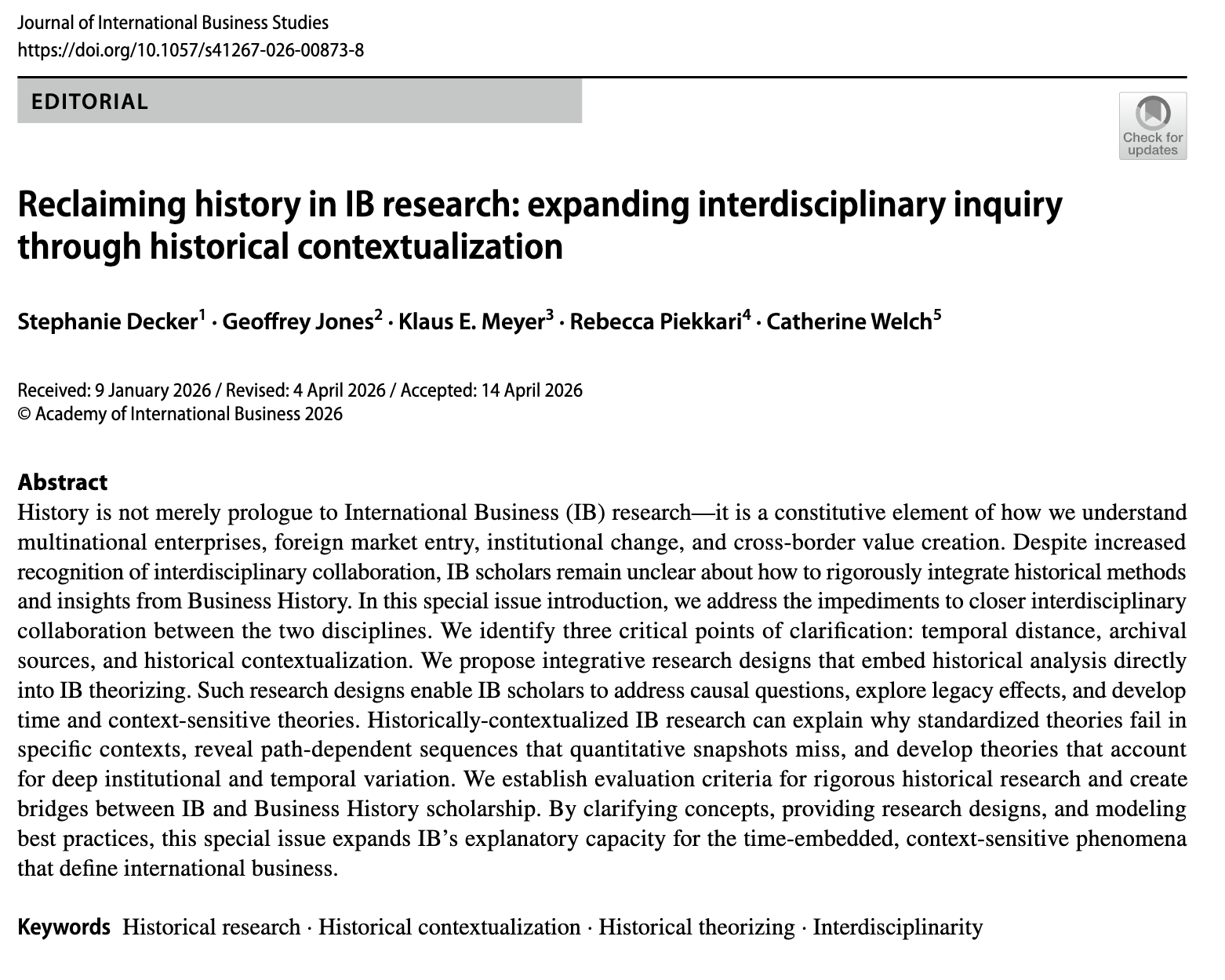
Really excited that the introduction for our forthcoming special issue in the Journal of International Business Studies has finally been published! We discuss the areas where IB and historical research differ, and how the two can be brought into closer conversation. The publisher sent me this free link for distribution.
2. AIB 2026 Historical Papers
This year’s Academy of International Business in Manchester offers pretty rich pickings for historians:
The Past, Present, and Future of the Multinational Enterprise: Implications for International Business and Policy
Chair: Jonathan Doh
In honour of the 50th Anniversary of Buckley and Casson’s “The Future of the MNE”
The panel examines which insights from the Future of the Multinational Enterprise are relevant, enduring, and applicable to present day international business and public policy contexts, and those perspectives that require updating, adapting, or abandoning in the present-day global environment. It further projects 50 years into the future, asking what we expect the role of MNEs, governments, and other international organizations to be and how they would compare to the perspectives from the book published a century prior.
Panelists:
Jonathan Doh, Villanova University
Peter Buckley, University of Manchester
Mark Casson, University of Reading
Sarianna Lundan, Aalto University
Jun Du, Aston University
Research Methods Qualitative Clinic: Historical Approaches in Management Research
This AIB research methods clinic explores the rich potential of historical methods for advancing management and organizational research. Led by Prof. Stephanie Decker, participants will explore how historical approaches offer unique pathways to theoretical development and empirical insight. Focusing on different approaches to historical research—from using history as an empirical setting to employing historiography as a theoretical resource—the clinic will provide practical methodological insights for international business scholars.
Facilitator:
Stephanie Decker, University of Birmingham
This session is organized by the AIB Research Methods SIG.
Fellows Café: MNEs and Populist Politics
Fellows Cafés are open to all conference participants. Please join us at this AIB Fellow led small group discussion focused on an IB topic of current and mutual interest.
Participating Fellow(s):
Klaus Meyer, Western University
Several countries have seen a rise in populist political parties, in some case they attained influence in governments. For MNEs, this changes key aspects of the institutional environment in which they operate. Starting from a historical perspective, the Café will explore the strategic options and ethical challenges MNEs face.
Revisiting the Past to Understand the Future: Archival Research as a Tool for Advancing International Business Scholarship [3.1.6]
Chair: Emmanuella Plakoyiannaki
Revisiting the Past to Understand the Future: Archival Research as a Tool for Advancing International Business Scholarship
Stephanie Decker, University of Birmingham
Giulia Galizzi, University of Vienna
Eriikka Paavilainen-Mäntymäki, University of Turku
Regulation and Technology
Chair: Shengwen Li
Geopolitical Projects Are What MNEs Make of Them: A Social Constructivist Perspective on Interfirm Relations in the Belt and Road Initiative in Africa
Simon Züfle, Reutlingen University
Geopolitical Strategy of MNEs: Effects of Corporate Governance Institutions
Chia-Wen Hsu, National Chung Cheng University
Yung-Chih Lien, National Taiwan University
Yen-Hsien Lee, Chung Yuan Christian University
Political Stability, Economic Policy Uncertainty, and High-Growth SMEs in Europe
Ignacio Requejo, University of Salamanca
Fadi Hawach, Bethlehem University
Chao Zhang, Northumbria University
Multinational Enterprises and Democratic Reversals
Stephanie Decker, University of Birmingham
Marcelo Bucheli, University of Illinois at Urbana-Champaign
Thomas DeBerge, Loyola University Chicago
3. ABH 2026 Tony Slaven Doctoral Workshop in Business History
2nd July 2026, in-person only
Henley Business School, University of Reading
8:30-9:00 Registration and welcome
9:00-10:30 Session 1 (Chair: Nicholas Wong, NU)
Paper 1
Jaclyn Hiebert (UoE) - Heritage brands: How history and sustainability influence the brand narrative
Paper 2
Helen Lu (UoB) - Passing the torch: The historical legacy of colonial occupation on modern corporate philanthropy
Paper 3
Olufunke Olawale (UWS) - Between two worlds: Dual embeddedness, kinship trust, and Nigerian diaspora entrepreneurs in the United Kingdom
10:30-11:00 Morning Break
11:00-12:30 Session 2 (Chair: Niamh Brennan, UCD)
Paper 1
Sophia Wigglesworth (UoY) - Responsibilisation in the pre-paid funeral market
Paper 2
Vanessa Pinheiro (UoY, UECE) - The historical organization of DNOCS in light of Historical Organization Studies and critical organizational history
Paper 3
Matthieu Kwasniuk-Zelazny (PSL) - Represent to control: A historico-ethnographic analysis of American managerial institutions in the twentieth century
12:30-13:30 Lunch Break
13:30-14:30 Session 3 (Chair: Richard Marks, Oxf.)
Paper 1
Simon A.C. Martin (UoS) - Brunel – The father of the high-speed railway, reframing the Great Western Railway through a business management lens (1835–1948)
Paper 2
Yasser Alvi (Cantab.) - Infrastructure finance as British geoeconomics: A comparative Study, 1840s–1914
14:30-15:00 Afternoon break
15:00-16:00 Session 4 (Chair: Simon Mollan, UoY)
Paper 1
Qinxian Zhang (UoG) - Comparison of the impact of the EU and the US antitrust laws on M&A strategies of multinational enterprises in the digital economy era
Paper 2
Carlito Junior (UNIRIO) - Merchant and tileworks owner: The firm Bulhões & Faria, credit relations and production at the Fazenda do Anhangá (Estrela, c. 1850–1882)
16:00-17:00 Joint Plenary Session on Academic Publishing
Chair: Lucy Newton (UoR), Former Associate Editor at Business History
Speakers: Adam Nix (UoB), Associate Editor and outgoing Book Reviews Editor at Business History.
Rosie Nix, Managing/ Administrative Editor, Business History
Michael Heller (NU), Editor of numerous special issues, former editor of the Palgrave Macmillan series Debates in Business History
4. ABH2026 Full conference programme
Main Conference Sessions
Parallel Session 1 1A: Archives, histories and approaches
Friday 3rd July 2026, 09.30-11.00 Room: 108; Chair: TBC
1. Who do archives serve? The organization of historical archives through the lens of historical organization studies and critical organizational history – Vanessa Pineiro (State University of Ceará/University of York), Ana Silvia Rocha Ipiranga (State University of Ceará), Gabriele Ferreira (State University of Ceará)
2. Business History in an other form: the Institute for the History of Aluminium (IHA) at the service of Business History - Léa Rémy (Institute for the History of Aluminium)
3. From Memory to Method: Oral History as a Bridge between Theory and Practice in Business History Education – Michaela Tasotti (University of Graz)
1B: Early Modern trade, finance and innovation
Friday 3rd July 2026, 09.30-11.00 Room: G10; Chair: TBC
1. Trade in Luxuries within the British Empire, 1697-1780 – Karolina Hutkova (London School of Economics), Noam Yuchtman (London School of Economics)
2. How did the 18th century businessman Christopher Wilson move money without using banks? – Richard Senior (University of Cambridge)
3. Who wants to be a Millionaire? Bankruptcy and Failure in the Pursuit of Innovation – Joe Lane (University of Reading)
1C: Retail, infrastructure and logistics in the twentieth century
Friday 3rd July 2026, 09.30-11.00 Room: G15; Chair: TBC
1. Motorways, Juggernauts and Supermarkets: The Transformation of British Freight and Retail 1958-1973 – James Fowler (University of Essex), Roy Edwards (University of Southampton)
2. Bricolage Dynamics and Strategic Renewal under prolonged scarcity: The Case of Sun Sun Department Store in wartime Shanghai, 1937–1945 – Guting Shen (University of Birmingham)
3. Managing Knowledge Across Acquired Stores House of Fraser and the Transfer of Tacit Practices – Yamur Gunduz (University of Reading)
Plenary Panel 1
New Directions and New Opportunities: Joint ABH-BAC Spotlight on UK Business Archives
Friday 3rd July 2026, 11.30-13.00
Room: G11; Chairs: Matthew Hollow (University of York); Mike Anson (Bank of England/BAC)
1. Philippa Mole - Head of Archive, The Guardian Foundation
2. Claire Tunstall - Global Head of Art, Archives and Records Management, Unilever
3. Caroline Gould - Principal Archivist, The Museum of English Rural Life and Special Collections, University of Reading
4. Phyllis Macfarlane – Chair of the AMSR’s Content Committee
Parallel Session 2
2A: Risk, trust and tax avoidance
Friday 3rd July 2026, 14.00-15.30 Room: 108; Chair: TBC
1. Asset Management in the Long Run: The Scottish Investment Trust 1888 – 2021 – Graeme Acheson (University of Strathclyde), Gareth Campbell (Queen’s University Belfast) and Patrick Herbst (University of Stirling)
2. Risk Management and Financial Innovation in Pre-WW1 London: The Case of Option Certificates – Dimitris P. Sotiropoulos (The Open University) and Oluwatoyin Dosumu (University of Manchester)
3. Tax Planning, Avoidance and Evasion: Business Profits in World War One Britain – Mark Billings (University of Exeter)
2B: Banks and banking practices across time and space
Friday 3rd July 2026, 14.00-15.30 Room: G10; Chair: TBC
1. New Zealand banking iconography in London: co-creating wealth in the context of colonialism and the British Empire – Billie Lythberg (University of Auckland) and Lucy Newton (Henley Business School)
2. The Bank of England and the rescue of Armstrongs, 1921-1936 – Valerio Cerretano (Università di Firenze)
3. ‘Emerging from the Shadows’, Britain’s Eighteenth-Century Direct Tax System – Amy Stanning (Lancaster University)
2C: The emergence and evolution of industries
Friday 3rd July 2026, 14.00-15.30 Room: G15; Chair: TBC
1. Football industry in Victorian England: a case study of industry emergence – Alessandro Giudice (Bayes Business School), Alessandro Giudici (Bayes Business School) and Paolo Aversa (King’s College London)
2. The Tyneside industrial cluster, 1840-1910: agency and ‘co-operative competition’ – John F. Wilson (Northumbria University) and Mark Stoddart (Northumbria University)
3. Responsibility in the Pre-Paid Funeral Market: 1980-2026 – Sophia Wigglesworth (University of York)
Parallel Session 3
3A: The State and Industrial Policy
Saturday 4th July 2026, 09.00-10.30 Room: 108; Chair: TBC
1. High tech state venture capital in the UK; the National Enterprise Board and Inmos – Leon Gooberman (CardiC University) and Max Munday (CardiC University)
2. License to Fail: The Rise and Fall of Indian Airlines under Postcolonial State Ownership (1953 – 1991) – Hrick Das (Queen’s University Belfast)
3. Varieties of Decolonisation: A Typology of Business-State Relations in Post-Colonial Contexts – Kondwani Happy Ngoma (Stockholm School of Economics) and Emmet Oliver
3B: Banking, finance and policy in the late twentieth century
Saturday 4th July 2026, 09.00-10.30 Room: G10; Chair: TBC
1. Barclays international expansion in Japan in the 1980s – Ian Jones (University of SheCield), Simon Mollan (University of York), and Ayumu Sugawara (Tohoku University)
2. Policy and access to credit: the Commercial Bank of Greece in the 1980s – Virgina-Anastasia Fournari (University of Thessaly)
3. Verifying the role of industrial policy in the development of the British pharmaceutical industry, 1957-1990 – Tom Buckley (University of Sussex) and Andrew Godley (University of Sussex)
3C: Industry during the nineteenth century
Saturday 4th July 2026, 09.00-10.30 Room: G15; Chair: TBC
1. Entrepreneurs and Empires: Role of Business Associations in the Rise and Fall of Sugar Industries in 19th Century Empires – Karolina Hutkova (London School of Economics)
2. Late Entry, Shared Know-how: The Czech Sugar Industry in the Nineteenth Century – Lucie Mařanová (Prague University of Economics and Business)
3. City Bankers, Iron Rails, and the Khedivate: Foreclosing on the Egyptian State Railways – Yasser Alvi (University of Cambridge)
Parallel Session 4
4A: Interdisciplinary connections within Business History
Saturday 4th July 2026, 11.00-13.00 Room: 108; Chair: TBC
1. Acid communism hippie libertarianism? Interpreting the business history of the Grateful Dead – Simon Mollan (University of York)
2. A Five Stage Model of the History of Internal Communication in the United Kingdom – Michael Heller (Newcastle Business School)
3. From under the system to part of the system: workers’ experience of scientific management in the twentieth century – Michael Weatherburn (Imperial College London)
4. Business History in the Mobilities Paradigm: Interdisciplinary Brokerage as Disciplinary Amplification – Simone Fari (Universidad de Granada)
4B: Institutions, regulation and networks
Saturday 4th July 2026, 11.00-13.00 Room: G10; Chair: TBC
1. Nineteenth Century Royal Charters: A Comparative Analysis of Four Charters – Sean Bradley Power (MBS School of Business) and Niamh M. Brennan (University College Dublin)
2. From Acts to Indices: A Policy–Based Measure of State–Business Relations in Britain, 1968–1990 - Maks Ludzinski (London School of Economics)
3. New data on the City-Industry divide debate: networks, financial elites, and industrial connections – Simon Mollan, Phillip Garnett, Chris Corker, Kevin Tennent, (University of York), Mark Billings (University of Exeter)
4C: Entrepreneurship, identities and society
Saturday 4th July 2026, 11.00-13.00 Room: G15; Chair: TBC
1. Gendering Enterprise: Jewish Women’s Social Activism in Early Twentieth-Century – Angelina Palmén (Uppsala University)
2. Sources for the Study of Chilean (Santiago-Based) Women Entrepreneurs in the Late Nineteenth and Early Twentieth Centuries: Possibilities and Limitations – Cecilia Morán (Universidad San Sebastián)
3. Survivors, Refugees, Entrepreneurs: Jewish Refugee Entrepreneurs in Britain, 1933-1971 – Scott Cairns (Liverpool John Moors University)
4. The failure of social enterprises: a historical analysis of social imprinting vs institutional pressure – Xiaoqing Li (Brunel University of London) and Zoi Pittaki (University of Dundee)
4D: Roundtable on Business History PhDs in the Business School: Interdisciplinary Challenges and Opportunities
Saturday 4th July 2026, 11.00-13.00 Room G11; Chair: Stephanie Decker
1. Beyond Context: How History Produces Theoretical Insight – Yamur Gunduz (Henley Business School)
2. Why History in Business Schools? Reflections from a PhD Researcher – Guting Shen (University of Birmingham Business School)
3. Perspective Taking: Understanding Business History Through A Japanese Lens – Jaclyn Hiebert (University of Exeter Business School)
4. Bridging Methods and Disciplines: A Quantitative Researcher’s Perspective - Hailin Lu (University of Birmingham Business School)
5. Doing Qualitative Business History Research in (an Increasingly Quantitative) Economic History Department – Tom Learmouth (London School of Economics)
6. Title TBC: Jessica Lomas (Henley Business School)
Plenary Panel 2
Business History and the Classroom: Reflections on Historical Informed Education
Saturday 4th July 2026, 14.00-15.30 Room: G11; Chair: Peter Miskell
1. Decolonizing Business History Pedagogy: Critical Perspectives for Learning and Education – Stephanie Decker (University of Brimingham)
2. Responsible Management and Business History: A Missing Conversation? – Adam Nix (University of Birmingham)
3. Business History Education in a STEM University Context – Michael Weatherburn (Imperial College London)
4. Recognising the Value, Purpose and Function of Teaching Cases in Business History – Nicholas Wong (Northumbria University)