


Another busy week with newsletters and updates out from several national business history associations and an important summary from the current state of the campaign to ensure that the BBC Archives remain accessible to researchers and the public. Also, call for papers for next year’s BHC in Mexico, and a workshop in Germany (in German), the new issue of Enterprise & Society is out, and the journal has an advance online review of Beckert’s Capitalism by Lipartito. Also an introduction to a Canadian business archive, and CBHA award winners, as well as the German business history association (GUG) on the AGI Symposium — and no, it is no artificial general intelligence!
Contents
BBC Written Archives Campaign
CfP BHC 2027
E&S new issue & advance online
Selected announcements
CBHA: Award winners
CBHA: Canadian business archives
AGI Symposium
CfP “Trade, insurance and monetary systems in the age of imperialism” [German]
1. Update from the BBC Written Archives Campaign
Welcome to our latest update about the Written Archives Centre campaign. We have news of an important breakthrough for staff and users, as well as some recent press coverage.
The win
A small number of WAC users meet with the BBC archives team three times a year to hear about plans and as a forum in which to raise concerns. As we explained in our submission to the government’s Charter consultation:
“it was confirmed at a user group meeting in November 2025 that staff at WAC - a superb team of professional archivists who assist with queries - have been instructed not to inform users of the existence of unavailable files. We believe this is also intended to minimise workload, as the information could legitimately be used as the basis of Freedom of Information access requests.”
To explain the last point, we are aware that a number of WAC users have been turning to the separate path of FOI in order to attempt to access the files they need for research. This is a legitimate process that has been effective in most cases that we know of but the process relies on the user first having the awareness that emails from WAC archivists will sometimes elide vital information. The staff would simply tell you about available vetted files. As matters stood, if a user then responded and specifically asked for information about unvetted files, the archivist would have to seek permission from a manager before responding. This was needless bureaucracy, delayed the process for the user, and was clearly an infringement on the professionalism of WAC’s archivists.
As was pointed out by users attending the November meeting, this policy - introduced by the Lead Curator - risked making us look foolish years down the track when files were then revealed to have existed all along and which contradicted our published writing on the subject. The Head of Library and Curatorial Services grasped why this was an issue, but it was not until six months later that she sat down with WAC staff in order to hear their views.
It has since been decided that WAC archivists will no longer need to seek permission from managers to share information with users about unvetted files. They will be free to use their discretion. However, it remains incumbent on WAC users to press for information about unvetted material.
Our advice is to keep this new arrangement in mind and consider asking in first instance for the file references and exact titles of both vetted and unvetted material relating to your area of interest. This will not be received as presumptuous or problematic, but an opportunity to give you a full answer.
The reason why we stress the importance of file references and exact titles for unvetted material is so that you can submit an FOI request with a degree of accuracy. However, please do not refer to that directly in your correspondence with WAC staff as it is not something they can get involved with. You are more than welcome to contact us at the campaign group if you need advice on this entirely separate and quite straightforward FOI process.
We consider this an important win for staff, and a win for the campaign to have affected positive change both for staff and users. It is of course less than ideal, and we continue to seek a restoration of the system of on request vetting, but it will make a positive difference for the time being.
Parliament
We are currently developing a campaign within Parliament as the Charter makes its way through the two houses. For those new to this mailing list we encourage you to look at our previous submissions to the Government consultation and the shorter version to the Commons Select Committee consultation. These documents sum up the campaign so far and the issues at stake.
Please get in touch if you have ideas or contacts who may take an interest in our determination to strengthen the status of the WAC within the next Framework Agreement between BBC and government.
Press Coverage
Finally we can now share with you the full text of the column in the June issue of Sight and Sound by its regular television columnist Andrew Male. Within his wider assessment of how the BBC is using its archive online, he includes comments from us on the situation at WAC.
We’ll be in touch with more updates in the near future.
Ian Greaves, Kate Murphy and John Wyver
2. CfP Business History Conference 2027
The Business History Conference invites submissions for its 2027 annual meeting, to be held March 18–20 at the Sheraton Mexico City Maria Isabel Hotel in Mexico City, Mexico.
The conference theme, Business History and Political Economy, focuses on the role of corporations as political actors that shape and influence the economic and political environments in which they operate. The program committee welcomes panels and papers that examine how firms develop strategies to influence these systems. Submissions addressing emerging or less developed economies, as well as corporations operating across borders, are particularly encouraged. Interdisciplinary approaches drawing on political science, economics, and sociology are also welcome.
The committee prioritizes fully formed panel proposals (3–4 papers, chair, and discussant), though individual paper submissions will be considered and organized into thematic sessions.
Each proposal should include a one-page abstract (300 words) and a one-page CV for each participant. Panel proposals must also include a cover letter with session details and organizer contact information.
Submission deadline: October 16, 2026
Submission instructions: https://thebhc.org/proposal-instructions
Notification of acceptance: December 15, 2026
Graduate students and emerging scholars are encouraged to apply and may be eligible for travel support.
Additional events include the Dissertation Colloquium and the workshop in Spanish, Tercer Taller “Empresariado en América Latina en Perspectiva Histórica y Global”, held prior to the conference.
3. Enterprise & Society new issue & advance online
You can find the new issue here.
I really enjoyed reading this advance online review of Sven Beckert’s Capitalism: A Global History:
Kenneth Lipartito. “Capitalism’s Wild Ride”, https://doi.org/10.1017/eso.2026.10133
Ken considers the book from the perspective of business historians, which I feel is urgently necessary, and he provides a very balanced read. Capitalism has increasingly become a byword for dealing with the economy and economic actors, if you do not want to get bogged down in the details of business and organising, or in national variations.
4. Selected announcements
Herman E. Krooss Prize for Best Dissertation in Business History. The deadline for proposals for the Krooss prize is November 14. Call now open for 2026 dissertations.
Henry Kaufman Financial History Fellowship Program. The deadline for proposals for Research and Dissertation fellowships is November 1 2026.
Hagley Prize and Ralph Gomory Prize Book Nominations. The deadline for publishers to submit new books for consideration for the best book in business history award is November 30. Four copies of each book must accompany the nomination.
The program for the World Congress of Business History is now available: https://unternehmensgeschichte.de/db/app/WCBH2026. As part of our Conference programming, we are excited to offer a series of podcasts about Toronto and its business history.
Episode One: “A Visitor’s History of the University of Toronto,” is produced by Dr. Steve Penfold and Dr. Louis Reed-Wood and tells a remarkable institutional story in twenty minutes, providing the context for our Conference site.
Episode Two: “A (Very) Brief History of Toronto,” produced and hosted by Dr. Steve Penfold and Dr. Louis Reed-Wood, gives a wonderful insight of the history of the city and how it has evolved into its modern form in twenty minutes.
Episode Three: “The Bata Shoe Museum,” takes a look at the Bata Shoe Museum, an absolutely unique and truly fascinating institution located just on the edge of the University of Toronto campus. The Museum is one of the optional events during the Congress. Our hosts talk to Elizabeth Semmelhack, Director and Senior Curator at the Museum, and discuss capitalism, labour, gender, the exhibits at the museum, and what shoes tell us about human history--and also that time when the Ontario Provincial Police brought a shoe mystery to the Museum.
CFA for the John E. Rovensky Fellowships in U.S. Business or Economic History (2026-2027) and the John E. Rovensky Fellowships in International Business or Economic History (2026-2027) is open through July 6th.
Networks of Creative Persuasion in Advertising and Marketing — Conference at the Hagley Library, November 6, 2026. Submit proposals of no more than 500 words and a one-page C.V. to Carol Lockman at clockman@Hagley.org.
19th Annual Meeting of the African Economic History Network — Gothenburg, Sweden, October 23–24, 2026. More information.
IX Congreso Latinoamericano de Historia Económica (CLADHE), que se celebrará en la Universidad Nacional Autónoma de México (Ciudad de México) del 28 de junio al 1 de julio de 2027. CFP here.
First call for sessions for the 2028 World Economic History Congress in Montevideo, Uruguay, is now open. The deadline is in September and sessions can be submitted here.
5. CBHA Annual Award Winners
The Canadian Business History Association (CBHA) is proud to announce four winners in our annual or biannual award categories. We wish to extend our congratulations again to:
Brian Gettler - who was awarded the 2026 Best Scholarly Article in Canadian Business History for his article titled: “The Vincent-Picard Family’s Investments: Wendat Wealth and Notarized Contracts in the Mid-Nineteenth Century.”
Clarence Hatton-Proulx - (a former CBHA Kobrak Fellow) who was awarded an Honourable Mention in the Best Scholarly Article category for an article titled: “The Role of Forecasts in Planning for Energy Infrastructure: A Historical Look at Past Futures in Postwar Quebec.”
Joe Borsato - who was awarded the CBHA’s 2026-2028 Kobrak Fellowship for his post-doctoral research project titled: “Vast Rupert’s Land: Prince Attash’s Voyage and Cree Commerce in the Seventeenth-Century Hudson Bay.”
Letian Wang - who was awarded the 2026 Desautels Research Fund in Private Enterprise, History & Law - for his PhD research currently titled: “Farewell to The Chinese Times” studies the demise of The Chinese Times (Tai Hon Kong Bo) newspaper in Canada.
Congratulations to all, and thank you for advancing the study of Canadian business history!
5. CBHA Archives Spotlight
Archive Spotlight! Explore the Business History Collections at the University of Waterloo
Did you know that Special Collections & Archives (SCA) at the University of Waterloo is one of the largest local history repositories in the Waterloo region? I spoke with archivist Nicole Marcogliese to learn more about their collections, specifically those related to business history in order to give the CBHA network an inside look at what is available to researchers.
Researchers can access SCA’s collections online in two ways: by exploring descriptive records in SCA’s Archives Database, or by browsing a curated selection of digitized materials in the Waterloo Digital Library. Both are excellent starting points for research; however, the Archives Database is particularly useful as it functions like an index and organizes materials into distinct thematic collection strengths that are clearly presented on the homepage.
For those interested in studying business history, be sure to explore SCA’s regional development, industry, and settlement collection strength, which provides access to descriptions of relevant materials. This thematic area includes numerous collections that support research on a wide range of business history topics. I selected two to highlight here:
Dare Foods Limited is a family-owned Canadian food manufacturer producing cookies, crackers, candies, and fine breads across facilities in Ontario, Quebec and South Carolina. The company began in 1889 as a grocery store founded by Charles H. Doerr, evolving into a biscuit and candy manufacturer by the early 20th century. Under Carl M. Doerr (Carl Dare), the company expanded internationally, introducing Dare products to over 40 countries and acquiring several food companies. The Dare Foods Limited collection in SCA documents the company’s operations and growth through records like account books, meeting minutes, letters patent, share registers, financial statements, and photographs as well as biscuit, cracker, and candy formulas and package samples.
Descriptive records for this collection can be found in the Archives Database here and a selection of digitized content from the collection can be viewed online via the Waterloo Digital Library here.
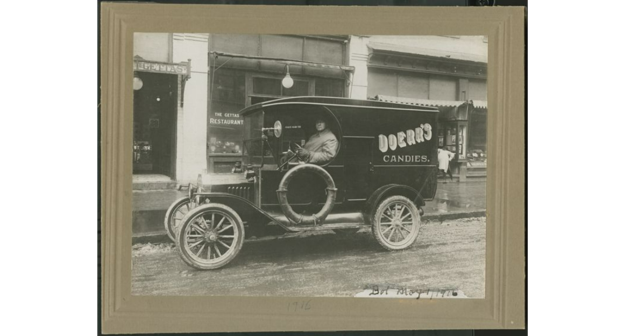
Photo caption: Photograph of John Doerr sitting in the driver’s seat of the Doerr’s Candies delivery car in front of The Gettas Restaurant. Citation: University of Waterloo Libraries. Special Collections & Archives. Dare Foods Limited fonds. C.H. Doerr and Company : Doerr’s Candies delivery car and driver. GA163-31-399.
The Dominion Rubber Company, a division of the Canadian Consolidated Rubber Company based in Montreal, was one of the largest industrial employers in Kitchener-Waterloo during the twentieth century. The company operated the Dominion Tire plant on Strange Street in Kitchener and later became part of Uniroyal. The company played a significant role in the region’s manufacturing growth, producing tires and other rubber products. The Dominion Rubber Company collection in SCA captures the company’s history through photographs, newsletters, administrative records, and other materials related to factory operations, employees, and corporate activities. These records provide insight into both the company’s development and the broader industrial history of the Waterloo Region.
Descriptive records for the Dominion Rubber Company collection can be found in the Archives Database here and a selection of digitized content from the collection can be viewed online via the Waterloo Digital Library here.
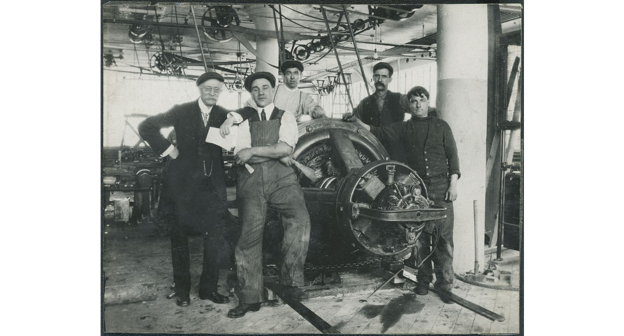
Photo caption: Photograph of Dominion Tire employees standing on the factory floor around a large piece of machinery and looking at camera. Left to right: Fred Tremble, Bert Lavigne, Bert Pinnell, unidentified, and Stan Boyes. Citation: University of Waterloo Libraries. Special Collections & Archives. Dominion Rubber Company fonds. Dominion Tire staff. GA335-7-430_016.
These are just two of the many business history collections in SCA at the University of Waterloo! If you would like to speak with SCA staff about these collections or explore them further in person, please find the department’s contact information below. Additional details are available on the Visit SCA page.
Special Collections & Archives
University of Waterloo Libraries
Congratulations to SCA on celebrating 50 years of preserving local heritage this year!
6. AGI Symposium
No, it is not artifical general intelligence, but a new joint symposium between Austria, Germany and Italy - below the description and announcement in German:
AGI-Symposium «Business History in Austria, Germany and Italy» in Rom
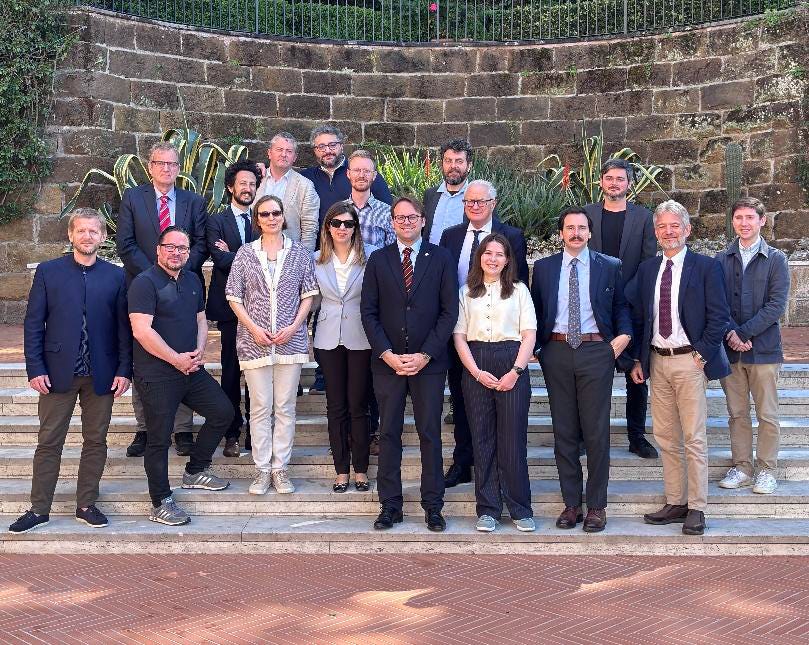
Die Gesellschaften für Unternehmensgeschichte in Deutschland (GUG), Italien (ASSI) und Österreich (ÖGU) haben ein gemeinsames Projekt ins Leben gerufen: Das „AustriaGermanyItaly“ (AGI)-Symposium, in dem das Fach Business History im internationalen Kontext diskutiert und weiterentwickelt werden soll. Konkret geht es dabei um eine Darstellung der Forschungsschwerpunkte in den einzelnen Ländern, aber auch um Praxisnähe sowie um Möglichkeiten eines Brückenschlages zwischen Wissenschaft und Wirtschaft. Das erste AGI-Symposium ging am 8./9. April 2026 sehr erfolgreich am Österreichischen Historischen Institut (ÖHI) in Rom über die Bühne. Die ÖGU dankt dem Team des ÖHI rund um Direktor Andreas Gottsmann sehr herzlich für die Gastfreundschaft!
Für 2027 ist nunmehr eine zweite AGI-Ausgabe fixiert, die am 1./2. April in der Deutschen Handelskammer Wien über die Bühne gehen wird.
7. CfP “Trade, insurance and monetary systems in the age of imperialism” [German]
Call for Papers
23. Sitzung des Arbeitskreises Bank- und Versicherungsgeschichte am Freitag, den 27. November 2026 im Hause der ODDO BHF SE, Gallusanlage 8, 60329 Frankfurt am Main
Handel, Versicherung und Zahlungsverkehr im Zeitalter des Imperialismus
Im Zeitalter des europäischen Imperialismus expandierte der internationale Handel in einem bis dahin nicht gekannten Maße und stellte damit nicht nur Kaufleute und Reeder, sondern auch die mit ihnen zusammenarbeitenden Banken und Versicherungen vor wachsende Herausforderungen. Diese betra-fen das erforderliche Wissen über neue Waren und Märkte, über neue Geschäftspartner, ihre jeweili-gen Handelspraktiken, Sprachen und sozialen Konventionen sowie – nicht zuletzt – die Bereitschaft zur Erkundung neuer Handelsrouten über Land und See sowie die Kenntnis der sich unter Umständen rasch wandelnden politischen Rahmenbedingungen. Aber was trieb diesen expandierenden Handel des 19. Jahrhunderts eigentlich an? War es in erster Linie die Initiative und das Gewinnstreben der Kaufleute und Reeder? Welchen Stellenwert besaß die staatliche Handels- und Kolonialpolitik?
In seiner 23. Sitzung möchte der Arbeitskreis Bank- und Versicherungsgeschichte diesen Fragen am Beispiel der Entfaltung des deutschen Handels mit und vor allem auch in Ost- und Südostasien im 19. Jahrhundert genauer nachgehen. Dabei sollen insbesondere die folgenden Aspekte erörtert werden:
▪ Welche Waren wurden von deutschen Kaufleuten und Reedern zu welchen Bedingungen und mit welchen Erträgen im jeweiligen wirtschaftlichen und politischen Umfeld der Länder Ost- und Süd-ostasiens gehandelt? Wie sahen die von ihnen vorgefundenen, veränderten und neu geknüpften Handels- und Schifffahrtsnetzwerke aus?
▪ Wie haben die deutschen Kaufleute und Reeder ihren Handel mit und in Ost- und Südostasien finanziert und versichert? Wie wurde der Zahlungsverkehr mit ihren Geschäftspartnern abgewi-ckelt? Mit welchen Banken haben deutsche Kaufleute und Reeder vor Ort und in Europa bevorzugt zusammengearbeitet?
▪ Welche Zahlungsbilanz- und Währungsprobleme ergaben sich aus dem expandierenden Handel mit und in Ost- und Südostasien? Wie konnten Handels- und Finanzkrisen wie etwa die von 1857 von den beteiligten Handelshäusern bewältigt werden? Welche Rolle spielten dabei die Zentral-banken?
Dieser Call for Papers richtet sich an Historiker:innen, die laufende oder abgeschlossene Forschungs-projekte zum diesem Thema präsentieren wollen. Der Workshop ist für Teilnehmer:innen aller Qualifi-kationsstufen offen, für Doktorand:innen in der Frühphase ihrer Dissertation bis hin zu habilitierten Historiker:innen. Vorschläge zu Vorträgen, die einen oder auch mehrere dieser Aspekte aufgreifen und exemplarisch behandeln, senden Sie bitte inklusive kurzer Angaben zu Ihrer Person (zusam-men etwa eine Textseite) als PDF-Dokument per E-Mail bis zum 17. Juli 2026 an die Ge-schäftsstelle der Gesellschaft für Unternehmensgeschichte e.V., zu Händen von Ralph Dieter Tarka, tarka@unternehmensgeschichte.de.