

Preparing the literature review
Tips and tricks that I both teach and practice - Part 2 of 2

Last, we discussed finding the literature (snowball metaphors included). But realistically, whether you are a student or an experienced (interdisciplinary) researcher, there is one thing that remains a problem…
There’s too much to read!
Most students don’t know that reading academic texts strategically will help them speed up their reviewing — and that AI is not necessarily quicker, or indeed better.
So here is the advice I give students — and which I received as an undergraduate at the University of Cologne, back in the days where the library catalogue was still on paper…

Don’t read from start to finish — academic books and articles are not novels
Start with the abstract, followed by the introduction and conclusion (if the abstract seemed relevant)
Once you have read these sections, you decide whether to read the article or if you are only reading some sections
The same applies to books, which may not have an abstract, but certainly have an introduction and a conclusion (most of the time…)
Learn to speed-read, and only read closely when you have identified something relevant
But, while that is all well and good, how to remember all the relevant sections, and integrate them into a coherent review?
How to take notes on your reading
The rest of the blog looks at a range of note-taking techniques, including resources and templates for the well-known Cornell method, which uses three different sections: the main notes, the “cues”, and the summary.
Referencing software, which is pretty essential in my view, also has note-taking functions, and depending on which one you use, you can combine approaches quite easily.
If you need something more systematic, the post includes a structured Excel template for you to download, which provides a clear approach to summarising a large body of literature.
Finally, some tips and tricks to put all these notes together into a coherent and convincing literature review that’s easy to follow and that sets up your ideas and contributions just so.
The Cornell note-taking method
This is a somewhat elaborate approach, but useful for those important pieces you may use again and again. It’s also a good option for students, as it helps them to synthesise and categorise, because it promotes active engagement with the reading.
Basically, it consists of a page with three sections (other than the citation on top):
A column on the left to highlight topics or most important insights
The main note-taking area on the right, occupying most of the page
A summary section at the bottom
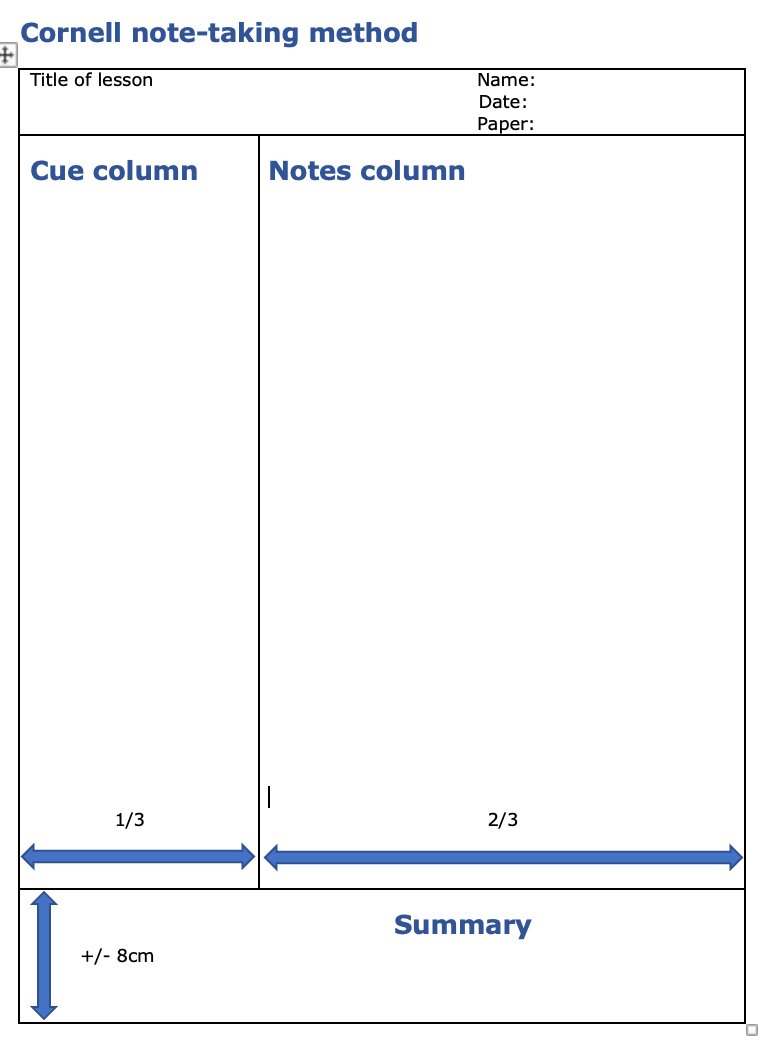
Designed to work for both note-taking in lessons and while reading, it can be adapted to help prepare for writing the literature review. It helps to get a sense of what they were designed for, and Cornell Learning Resources has some useful guidance available.
And while research shows that handwriting works best in terms of retention, there are plenty of paperless options available:
Make your own template in Word
Or perhaps you use a Remarkable or Kindle Scribe, in which case all you do is draw an I on the page and get started!
Referencing software
Referencing software is great IMHO, even though this means you spend some time maintaining your collection. There are normally note-taking options available in all the different options, so it comes down to personal preference to some extent.
I tend to tell students to start using a referencing software at the beginning of their project, because it does several things:
Save time when it comes to formatting at the end
Provide a central place to log all reading and literature searched
Stores notes and serves as a reminder
As an academic, working with various co-authors can be tricky if everyone uses a different referencing software, so we normally get one author to take over referencing.
Like many people, I started with EndNote, for which universities usually hold a group subscription. Truthfully, I find it clunky and haven’t used it for years. Then a colleague suggested Mendeley, which was great for many years, but since they went through a major update, it became buggy and difficult to manage.
I switched to Zotero, which over the years has become really good, and has lots of good ways to include notes either directly in Zotero or attach notes made in documents. But always happy to hear about other tools that work well.
Some colleagues tell me they just reformatted their references with AI — which sounds like a great option. When I tried it, I was not so impressed: too many references missed, and the inconsistencies meant I still had to go through and check all of them manually… which is precisely the kind of time-consuming, mind-numbing work I’d like to avoid by using AI.
What do you use? Let me know in the comments, and why you like it!
Summarising the literature through a dedicated template
Using a template to review, compare and contrast the literature can be very helpful, especially where there is a range of articles in an area that is new to you and you need to get a handle on.
The template below, other than the obvious identifiers for the article or book (author, year, title, journal), features column headings that are generally relevant in social science research:
Topic or theme
Theory employed
Method adopted
(I hid “sampling” and “sources of data,” as they were not so relevant for these examples)
Contribution
Key concepts
Context
Limitations/future directions
General notes (anything not picked up earlier)
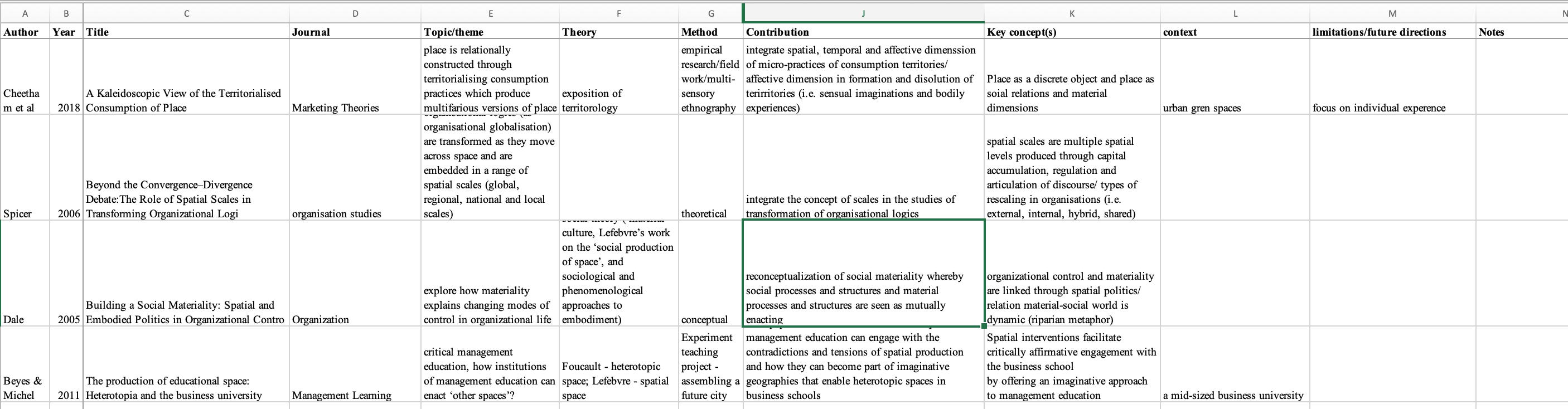
Click on the button below to download an example spreadsheet — it’s a normal Excel file, and you can adjust the rows as well as the headings to what is relevant to your research approach.
Interestingly, you can use Elicit.ai to generate similar spreadsheets where the tool extracts information from PDFs uploaded. In my experience, the tool is geared towards scientific and medical research — if you ask it to extract information on social scientific concepts or categories by yourself, it is less useful.
But more on AI tools and how to use them to support literature reviewing soon - there are some interesting options out there that can really help speed up the review process.
How to structure your literature review
Now, you are ready to write up your notes!
Sometimes it helps to go back to basics and set aside your readings and notes for a moment to focus on what you want to say. I like focusing exercises to get me back on track to achieve what I wanted to say.
Focus exercise (10 minutes)
Set a timer and take a piece of paper. Use the writing prompts to start thinking about how to structure your literature review.
My research question is … (50 words)
Researchers who have looked at this subject are … (50 words)
They argue that … (50 words)
Debate centres on the issue of … (25 words)
There is work to be done on … (25 words)
My research is closest to that of X in that … (50 words)
My contribution will be … (50 words)
You can download this as a worksheet by clicking on this button:
After the focus exercise, think of the structure
Literature reviews are complex; it helps to make the structure simpler and more logical. Invariably, I find it impossible to deal with more than three major topics per literature review — two is even better.
These topics can represent theories or subjects and the diagram below shows them as big circles. However, beyond signalling that you know and understand these fields, these are not the focus of your review.
The focus should on the areas where the circles overlap.
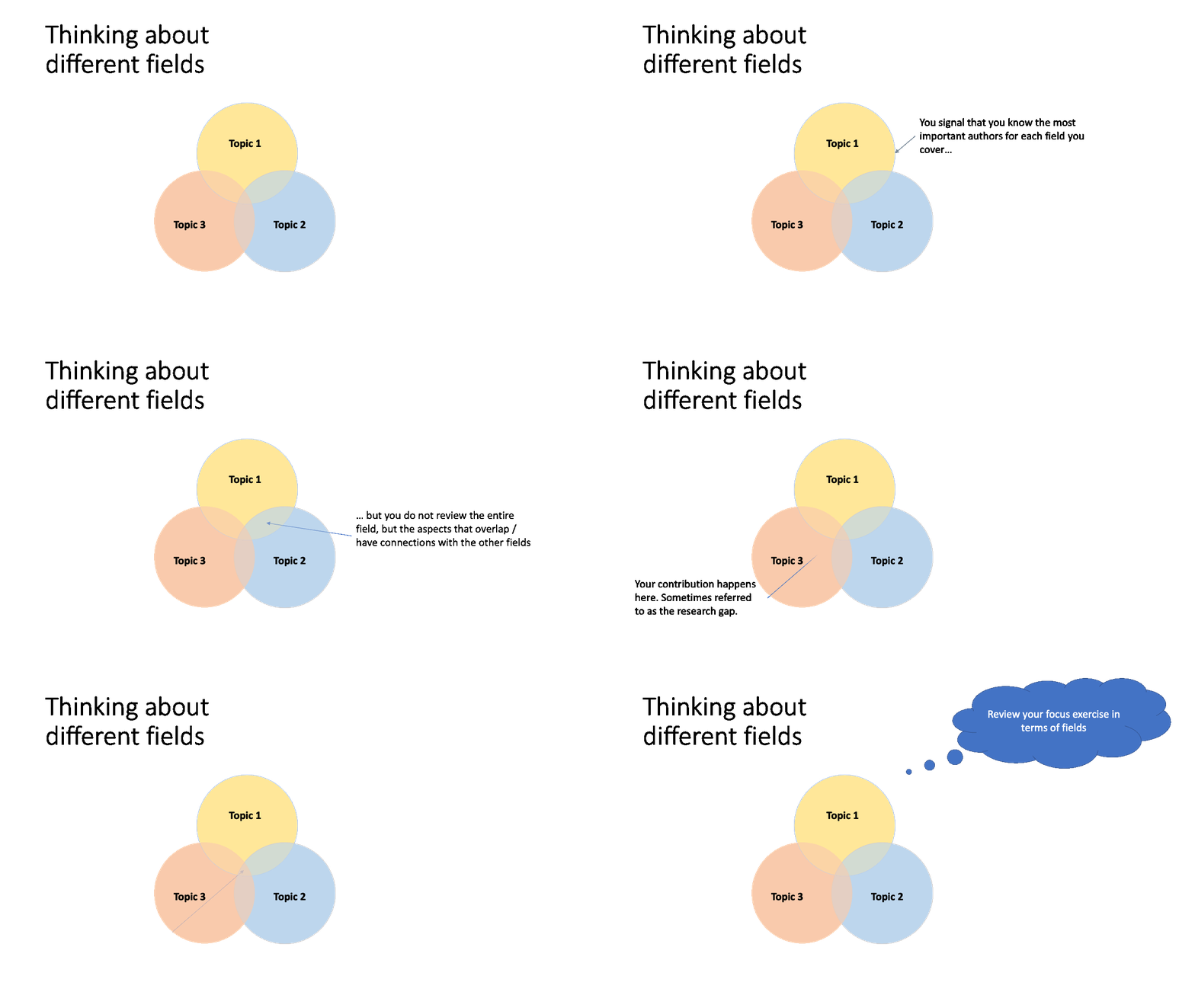
At the centre of this Venn diagram should be your research question. And if you imagine this with four or five circles, it is immediately clear that you are overloading your review.
Conversely, with two circles, the overlap is much easier to define… So unsurprisingly, interdisciplinary researchers and those who seek to contribute or bring together fairly fragmented fields encounter much greater challenges in writing a convincing review.
There is also the concept of the “funnel”, the idea that you structure a literature by going from the general to the specific. With three general topics, this is clearly not a straightforward process. (Much easier, again, if you can focus on two areas of literature.)
The Venn diagram can be helpful thinking through how you want to structure your literature review, and whether this structure would represent a logical order that allows you to take your reader through a sensible progression of your argument.
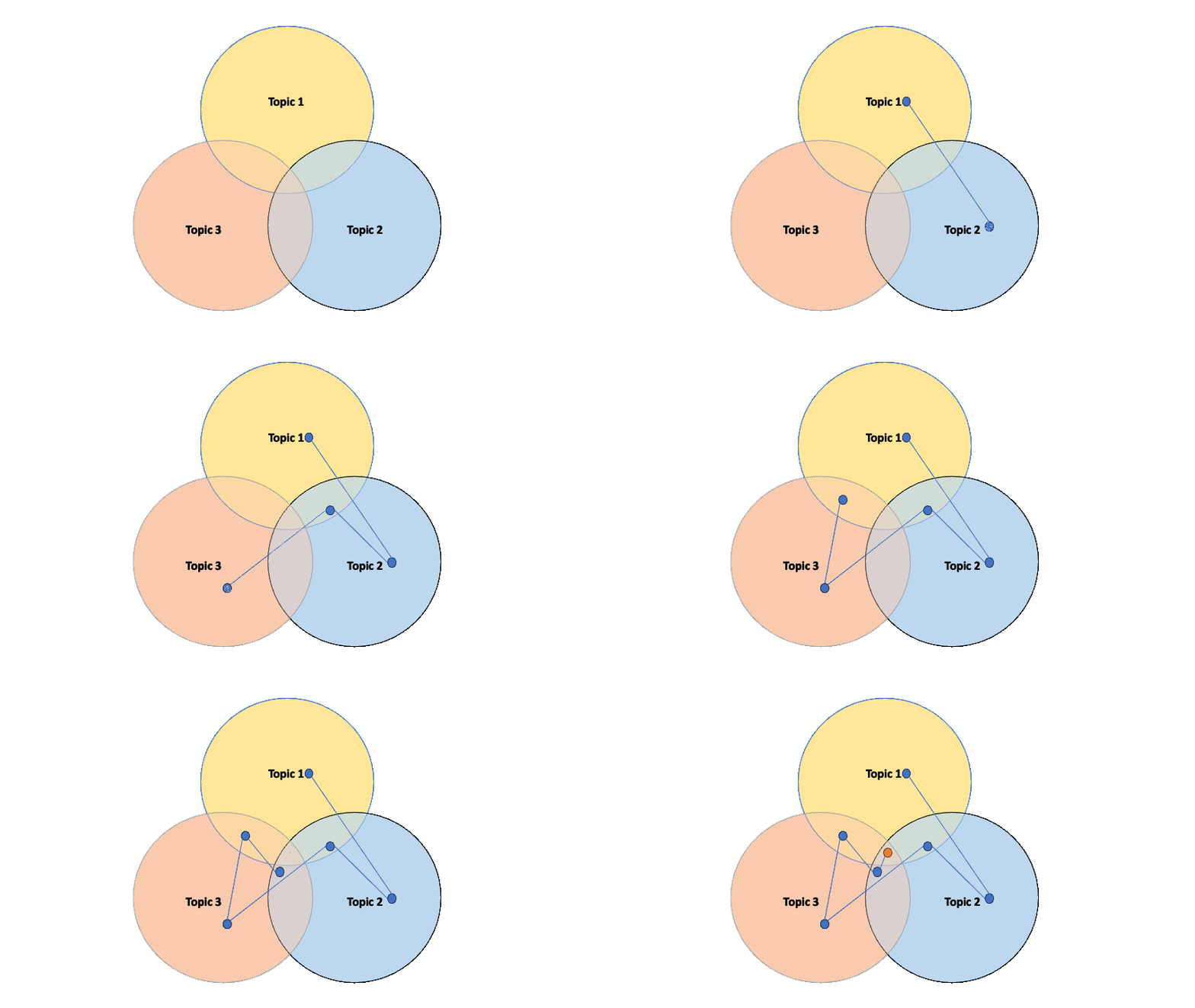
The example below represents a structure that usually works:
Introduce the first topic, then the second
Then discuss the area of overlap relevant to your research question
Then introduce the third area of interest
Followed by a discussion of how it is relevant to topics 1 and 2
And at this point, your research question should derive from the areas you discussed.
Writing the review
Contrary to current assumptions, AI tools do not deliver perfectly formed and well-argued literature reviews. They can be great tools to support your work, but you need to be competent to work with and improve the outputs of the tools.
If you find yourself falling into the laundry list approach to writing, which goes somewhat like this: “he said/argued/proposed ... she said/argued/proposed ... and then they said…”, then it is time to invest some time in your ability to write.
AI tools can fix your writing style, but they do not really help you clarify your thinking. They can be a crutch, but a crutch is less useful if you do not know how to walk!
Taking away the opportunity to struggle with how you want to express your thinking also takes away an important cognitive practice that supports thinking: writing. While you might think this is about your ability to express your thoughts on the literature, I’d advise you to look at this really short and practical book:
Graff & Birkenstein (2018) They say / I say: The moves that matter in academic writing (4th ed.)
Not only does it give you the phrases and rhetorical moves, it also makes it clear that setting up those rhetorical moves is part of you constructing your argument.
Further readings and suggestions
Hopefully, this two-parter was useful, and it helped you with coming to grips with the literature review. There is more good stuff out there that really informed my practice, and below is a selection of resources you might like:
Pat Thompson (University of Nottingham) has a handy blog, where she outlines why literature reviews can be such hard work: Part 1 and Part 2, both worth reading.
Here are some useful tips from Patter on how to prepare for writing about the literature.
Chris Hart has written two helpful books:
If you are struggling with finding a research question, these two books have some good ideas on how to get started:
Booth, Colomb & Williams (2016) The Craft of Research (4th ed) Ch. 3
Patrick White (2017) Developing Research Questions (2nd ed)
Good luck with your next literature review!!