Last week, I attended the British Academy of Management conference and the BAM Fellows panel session. I am vice dean of the BAM Fellows and helped co-organise the session, so it would have been odd if I hadn’t been there, really.
The discussion covered many interesting issues, but at some point the panellists noted that the business and management community in the 1980s and 1990s focused on improving research quality. Panellists agreed that this phase was over, and that quality was now very high - much higher than other disciplines. Gerard Hodgkinson reflected that someone he knew started studying history, and through this he found out that all historians do is root around in archives.
I kid you not:
The audience started to murmur.
Some people turned to look towards me (seated conveniently right in the middle).
I had planned to make a comment to Gerard after, but then I just went:
“But that’s not what the historians in the business school do, Gerard.”
And Gerard, bless him, went:
“That’s exactly what I mean.”
And while this is a lovely anecdote, I am also relaying it here because I think he is right. Being in the business school has really forced historical researchers to think more deeply about what we do and how we can make it transparent.
And the article I co-authored with Emmanuella Plakoyiannaki and Elena Giovannoni about historical imagination has been an important part of this journey for me.
So today is part 2 of my longer post about historical imagination.
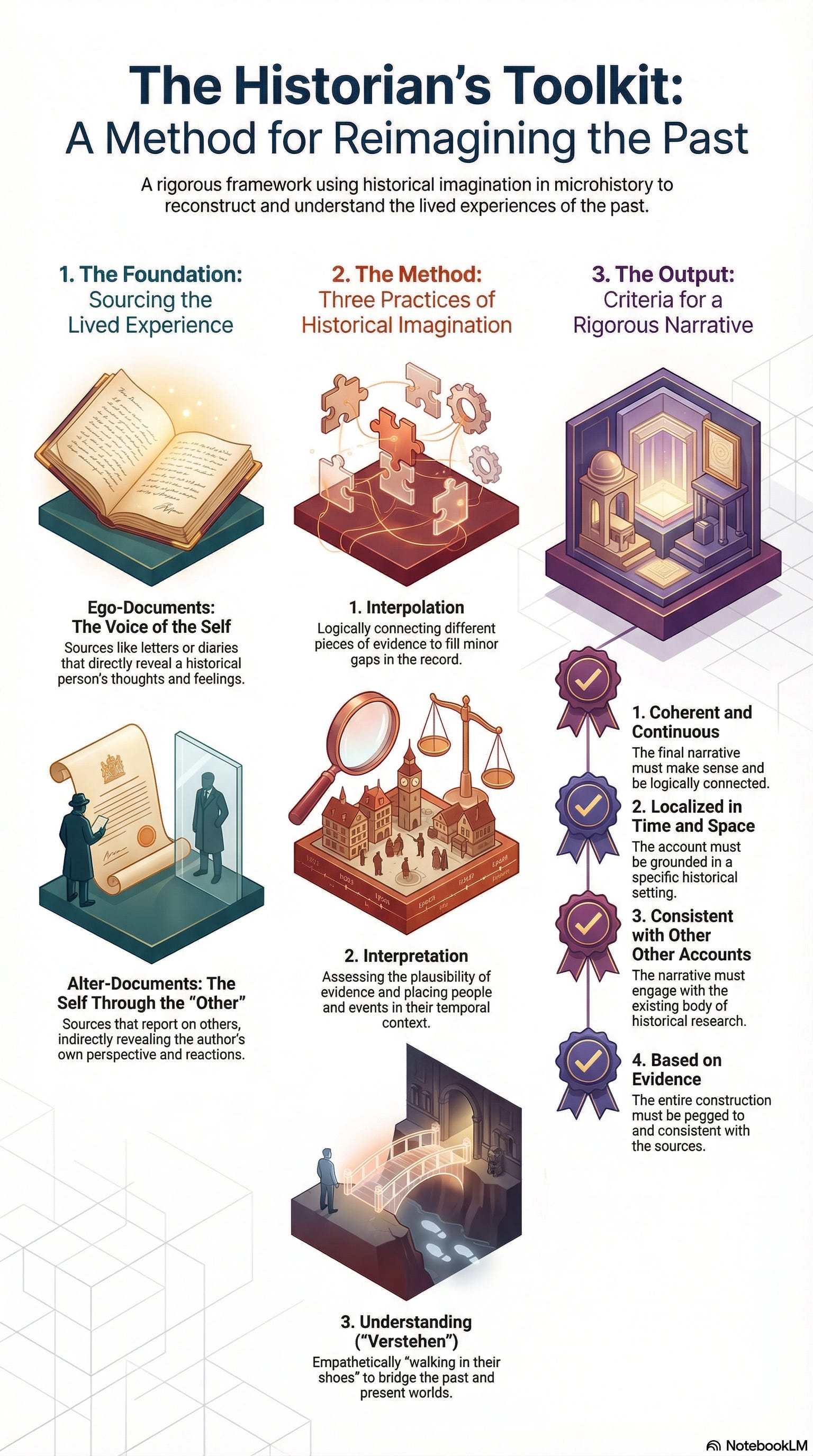
In part 1, we looked at the three-step process of gleaning meaning from sources, through interpolation, interpretation, and understanding.
And yet, for the resulting narrative to be considered historically rigorous, there are four important standards that Collingwood set out.
The four standards
While we based the four standards on Collingwood’s criteria for a rigorous historical narrative, these are somewhat adapted and brought up-to-date:
The narrative makes sense, and is continuous and coherent.
The narrative is localised in time and space.
The narrative is consistent with other historical accounts.
The narrative is based on evidence.
Some of these may look straightforward (sure, evidence), others have raised questions when we presented this (particularly 3). They go together with the three practices that form the basis of historical imagination.