

What is social entrepreneurship?
The historical timeline of change

Today’s guest post is by Kerryn Krige, Senior Lecturer in Practice – the Marshall Institute, London School of Economics.
What is social entrepreneurship?
It is a question that scholars have been grappling with, eventually coming to the uneasy conclusion that there is no universal definition, nor should there be. If we are comfortable with our loose understanding of democracy, then we can be comfortable with a field that both lacks definition and boundaries.
But this ambiguity is pronounced when you are teaching, facing a classroom of curious students who have all course-selected so that they can graduate with clarity on what social entrepreneurship is, why it is important and how to do it. Trotting out the patter that there is no definition and we must move on, doesn’t hold.
And so, I began to search for another way for us to explore and understand what the “social” in social entrepreneurship truly means.
Here, clarity emerges when we look to the past.
In the late 1890’s industrialist Charles Booth and his small team of researchers started walking the streets of London, talking to policemen, publicans and religious leaders. They visited schools and workhouses, diligently transferring the notes made by administrators who captured the needs of people seeking help.
Booth’s poverty maps are well known – and are very accessible through the digitised archives created by the LSE Library team[1].
But less well known are the Stepney Union case books[2] which record in short detail, the lives of people seeking help from the Charitable Organisation Society (C.O.S), a pseudo welfare agency, which decided who was worthy of receiving funds for essentials like food or medical expenses.
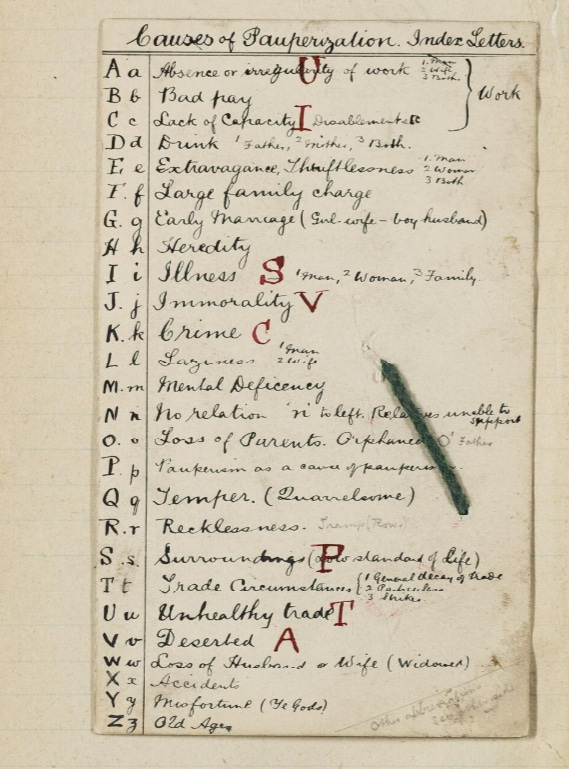
Emerging through the texts is the competing narrative of poverty as a moral failing, a consequence of drink, laziness, extravagance and immorality, contrasting with poverty as the consequence of life events: a workplace injury, the death of a husband, sickness and old age. Booth, ever the researcher, created an alphabetised list of the causes of pauperism (poverty) which runs neatly through the case-texts.
The case books allow us to explore what it is we mean when we talk about social change.
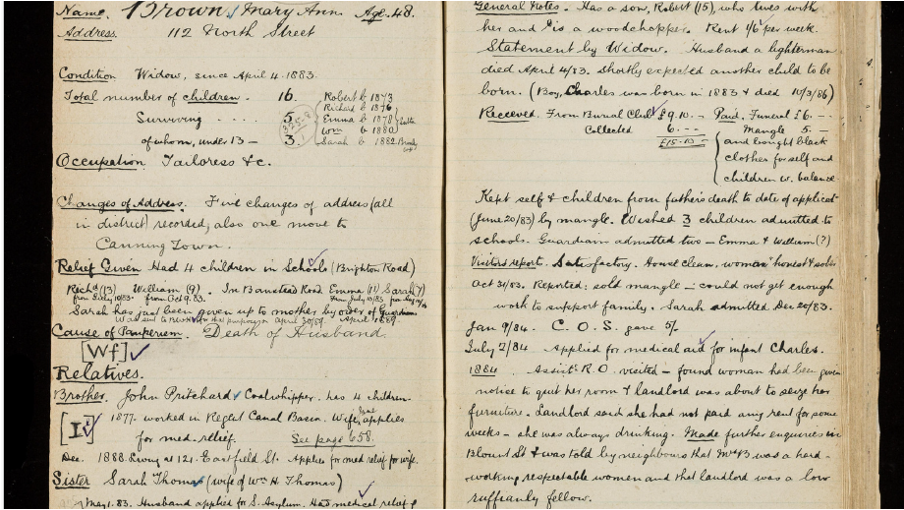
The first entry in Notebook A (Booth B / 162) is for Mary Anne Brown, aged 48 who is again facing eviction after losing her husband. Mary is mother to 16 children, of which only 5 are alive at the time she meets the C.O.S administrators, including little Charlie, who is born after her husbands’ death. Captured in the Receiving Officers precise hand are the notes of Mary’s life – her efforts to get medical help for Charlie, her requests to have her children schooled. She tries to earn money, but eventually sells the mangle she bought with the insurance pay-out from her husband’s burial society. Her daughter Sarah, at age seven, is taken from her, to the Bromley workhouse. And then there is 3-year old Charlie’s death, on the 10 March 1886, and Mary’s request for money so he can be buried.
Mary’s story allows us to see the devastating conditions of poverty, but also because of the timeline, to explore the underlying causes. What are the dynamics between power and authority that determine the life that Mary leads? What distinguishes poverty from inequality? Is our modern-day narrative of systems-seeking change, feasible when you look at the slow timeline of change? And are we guilty of continuing to moralise poverty, idolising self-sufficiency and entrepreneurial action as a redemptive pathway?
There are many benefits to using a historical lens in teaching social change. My top two are:
That looking back in time brings temporal distance, and with this, an impartiality that encourages analysis. It also helps build an inclusive classroom. Because no-one student has more knowledge than another, it dissolves advantage and encourages open discussion. Students can evaluate not just the difficulties that Mary experiences, but also what has changed since. Gender for example: in Mary’s time she had no legal voice, or vote. Her work opportunities were casual and bound to domestic labour – laundry, tailoring, caring or cleaning. What has changed? Yes women can vote, but women remain bound to roles of care, domestic labour is largely un-waged and the gender pay gap persists.
This allows students to appreciate the slow (long) timelines of profound, systems change and to identify how most ‘social’ work occurs at the symptomatic level: we intervene by providing housing, or education and food. But dismantling the structures of power and authority that bind Mary to her circumstances? This takes inordinate time. This analysis opens discussions on how we view poverty, not just as material deprivation, but as a lack of power. And challenges us to move away from the casual change-the-world, solution-seeking narratives that dominate mainstream discussions.
What the historical lens does is bring perspective. It helps us to understand complex, concepts, and to challenge the questions we ask. It helps us address our own moralising as social entrepreneurs, and to think critically about our cultural interpretations and motivations of ‘doing good.’ And the analytical distance that time brings allows us to see what is invisible, and through that build our understanding of the causes of things. With this, we can start building our understanding of what social change is, and how we approach our work, as social entrepreneurs.
You can view a transcript of the entry of Mary Anne Brown here:
[1] The LSE Booth archives are available here: https://booth.lse.ac.uk/map
[2] Stepney Union Casebooks: https://booth.lse.ac.uk/notebooks/stepney-union-casebooks
 | A guest post by
|
John Wilson flagged an interesting article published in Business History related to this post: Social entrepreneurship and the social economy of Victorian and Edwardian Britain
Mairi Maclean,Charles Harvey,Michael Price &Victor Harlow; Published online: 10 Jan 2025 https://www-tandfonline-com.bham-ezproxy.idm.oclc.org/doi/full/10.1080/00076791.2024.2447268