


Last month I had to explain to a recruitment contractor that the university does not shut down in August.
He had assumed that once he started, nobody would be around to answer his emails, on the reasonable-sounding basis that the students are gone. I let him down gently. There is no version of my (or anyone else’s) August with four spare weeks in it.
Catch-up service:
Rewind: Last year’s Substack summer post - with added Kurt Vonnegut
Do you have time for writing? Good. More posts are coming on that, but in the meantime, check these out:
Some light reading needed for the break? Why not enjoy a historical analogy?
I just had a galling rejection. So trust that I know what I’m talking about when I talk about academic rejection. At some point I might have calmed down sufficiently to be able to take my own advice…
When I mentioned this on LinkedIn in response to a funny post, colleagues arrived with their own versions pretty quickly. The assumption that we get three months off. The difficulty of fitting even a fortnight into that window. The additional confusion if you are part-time in academia and freelance the rest of the week. One colleague added that our non-academic friends and family all think the same.
I can relate: until about ten years ago, my mother would ring me midday, midweek, and open with “Are you working?”
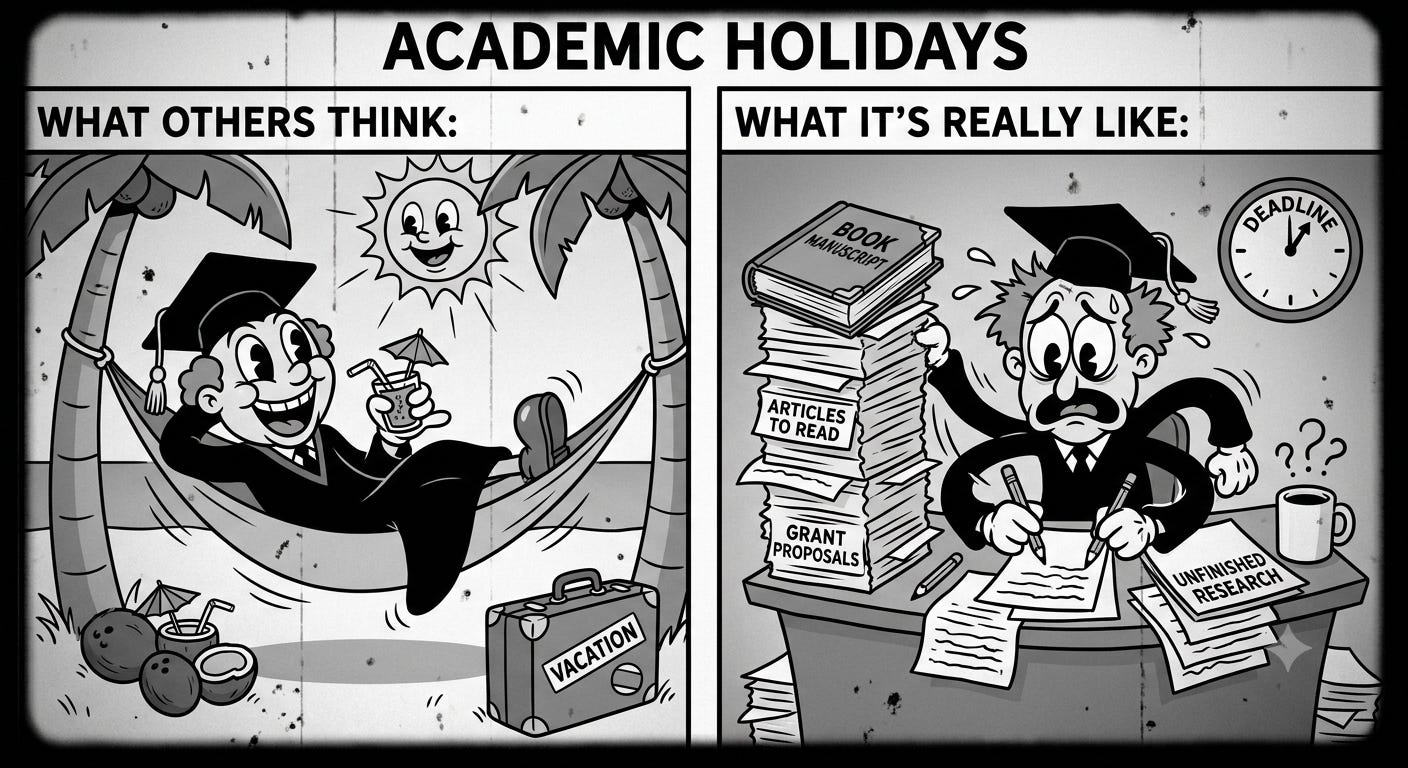
From the outside, this seems a logical assumption: Students go home, therefore the work stops. Only not all of the students leave, and we do more than just teach students.
The students are … not gone
Last summer, I was at the World Economic History Conference in Sweden, and I took time out from sessions to do online meetings with MSc dissertation students (I supervised 11). My continental European colleagues were disbelieving: “But… it is summer!”
Maybe there are places where academics can take the summer off. In the UK, Masters dissertations are traditionally supervised over the summer, presumably a holdover from when a Master’s programme would recruit 12-15 students.
One of our Masters programmes, the one I teach on, was designed for 120 and recruited 400. When this dropped to 300 last year, we had to launch a January intake at short notice, to make up the numbers (I kid you not). My colleagues are now block-teaching into June and July on that one.
This year I supervise MBA dissertations. My students religiously book my office hours weeks in advance, and I can see five meetings for August already. So I go to the office most weeks, still two to three times per week. It is quiet, sure, but I bump into other colleagues all the time.
Why August is the one time of the year when email slows down (other than Christmas)
Academic work has no natural stopping point. There is always another paper, another review, another revision. What actually determines whether you can take leave (other than the school holidays, for some) is not how much work you have (which, by the way, you cannot hand over, as it is personal to you). It is whether somebody else can legitimately give you a deadline.
In term time they can, constantly. Teaching, marking deadlines, exam boards, committees, the whole machinery of academic labour controlled by other people. June and July are often brutal precisely because the teaching has stopped and everything deferred until “after term” lands at once, plus you are committed to attend conferences.
August is the one month when this is not the case. Our senior team and education leads are explicitly trying to keep August free of deadlines and meeting invites – I was on a call when they had to stop an administrator from scheduling a whole bunch of people for August. Because they work like anyone else, too. So this is the one time when everyone can go and not fret what they will find in their inbox when they are back.
Which is why the recruitment contractor was wrong in an instructive way. He thought August was empty. It is not. We are defending it against the continuous expansion of demands as the conventions of academic teaching, once bespoke and elitist, creak under their expanded demands. A large part of this falls on the business schools, so basically, nobody really cares. Also, I suspect, the parents don’t want their adult children at home for too long.
The bit nobody has told you
On 6 April 2026 a new duty came into force. The Employment Rights Act 2025 inserted a record-keeping requirement into the Working Time Regulations 1998. Employers must now keep adequate records demonstrating compliance with statutory annual leave entitlement, holiday pay, and payments in lieu of untaken leave on termination. Records must be retained for six years. Failure may constitute a criminal offence.
Employment lawyers looking at higher education have already identified the sector’s particular exposure. For the first 10 years of my career, academics basically did not book or record annual leave at all.
We used to consider it as a form of autonomy that we did not need to log anything and everybody is trusted to manage their own time. I got used to booking my annual leave formally in the mid-2010s. People complained, but I quickly realised that I never took my whole leave entitlement, and it made me take more time off than I had previously.
An unrecorded leave culture is the precondition for invisible workload.
If you want to take a busman’s holiday, that’s your choice. I might have to, because I have to do something like one review per day for one journal or another at the moment, and it is beginning to really, really grate right now. Could we please all take a break from Manuscript Central and Editorial Manager for a bit?
For full subscribers, a cool app and website that helps you sell any books you no longer want, and make sure those second-hand and antiquarian bookshops you like to hang out in are well-stocked. Also a bit of a reading list on the current Pangram police controversy raging over here on Substack — required reading before returning in September to debates about whether student work should be scanned by Pangram for AI use.