



Today, we have a guest piece by Omeghie Okoyomoh, one of the doctoral researchers I supervise, in which she shares the lessons she's learned over her three years of study. She discusses how to develop a healthy attitude towards the PhD and offers a counterweight to the doctoral drama that dominates social sites.
And imagine my relief when she says she didn't write from the perspective of a toxic supervisor (cheque’s in the post :-) ).
You don’t have to romanticise burnout to earn your degree.
It’s Day 1 of your PhD, and you’ve made it! Through the cold emails to supervisors, rewriting your writing sample, the scholarship applications (I finished mine between hair and nail appointments on the eve of my best friend’s wedding), and the endless admin involved in finally getting admitted. Or maybe, like I am, you’re already three years into the journey.
If you’re anything like me, you spend hours on r/PhD (Reddit community), follow a bunch of PhD influencers, and watch 2,400 TikToks a month about the PhD experience. Most tell you how your supervisor now owns your soul. Many creators wear their mental breakdowns like a badge of honour, while others are trying to sell you some tool that you absolutely must have to survive the next 3–8 years of your life.
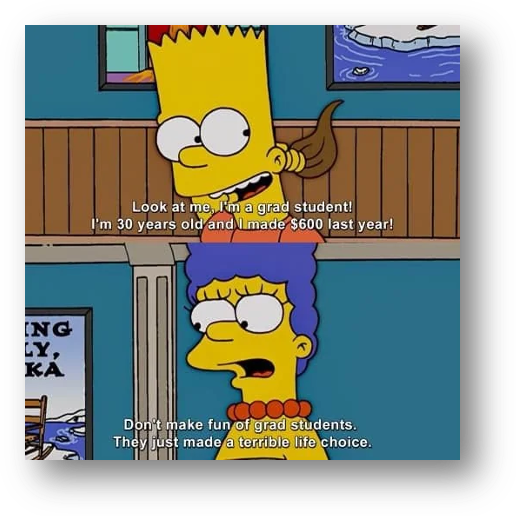
Let me cut through the noise for you. Based on my personal experiences and countless conversations with other PhD students, both within and outside the UK, here are 10 no-nonsense tips for surviving your PhD.
1. This is a job, not your identity.
You must learn to compartmentalise and understand the difference between who you are and the work you’re doing. This ensures that every problematic stage of your research doesn’t begin to feel like a personal failure.
No, you’re not a bad PhD student because you’ve written seven versions of your literature review and there are still ninety comments. Sometimes you’re navigating a complex area, and it takes a little time. Don’t take the bad days personally. That way lies frustration and extreme burnout.
2. Embarrassment is a useless emotion. Let it go now.
Not everything you try will work. In fact, you’ll probably encounter more dead ends than successes. Shake it off and move on. Try a new theory. Build a different experiment. Rewrite the paper from scratch.
Having to do something over isn’t failure; it’s evidence that you’ve learnt something new. That theory you spent three months working on may not work for this paper, but it’s in your toolbox now. You’ve got a long career ahead of you and enough time to whip it out again.
3. Be intentional about enjoying your experience.
There is no reward for misery. You don’t get an award for being “the most intense PhD student”. Get out of the office and go touch grass.
Guilt around rest and recreation is such a common theme in conversations with PhD students, particularly when progress isn’t following the ‘efficient PhD’ timeline you’ve set for yourself.
I know it’s hard. I do it too. I spent half my holiday in Albania wondering whether I should have stayed behind to focus on that journal article due in a month. But being tired in the office isn’t going to get you to that deadline.
Before I left for my trip, I was ready to print my paper out and burn it in the bathtub. By the time I returned, I was clear-headed enough to try something else. It worked, and the paper is finally back on track.
4. Build the community that works for you.
Figure out who you need and actively work to find them. If you need accountability partners, go out and find them. If you need cheerleaders, do the same. Some people are lucky enough to find everything they need in their supervisors or their lab. Others need to be a little more intentional.
Don’t whine about it. Don’t pretend you don’t need anyone. Go out and find the people you need.
5. An idiot in motion will go further than a genius at rest.
I have a love-hate relationship with this axiom. But, boy, does it work!
The biggest mistake I keep making is waiting until everything makes sense before I start writing. It’s the perfect excuse to keep delaying that first word for months on end.
Write the nonsense draft. Even better, send it out for feedback. I’ve received some pretty hilarious comments on my writing drafts. I love them! And it’s incredibly satisfying when the next round of feedback addresses something else entirely. Previous issues fixed; on to the next. Progress!
Don’t be afraid to look idiotic. It’s better than having absolutely nothing to show.
6. Move on!
I’ve seen colleagues lose weeks to frustration because of roadblocks in their work. There’s a reason resilience is always on the list of skills a PhD is supposed to teach you.
So, things didn’t work out. Take a moment to acknowledge how much it hurts. Then show up again the next day and find another route. A friend spent half a year and a lot of money chasing data in an actual jungle that was not worth so much in the end. She sat with her supervisors; they re-strategised, and she’s moving forward.
7. Make use of all the resources available to you, and I mean as many as you need.
Go to the library for writing and research support. Join community groups and apply for mentorship schemes. My university offers a subscription to The PhD Lifecoach. I finally signed up in my third year. I should have done it in my first!
Find the resources available at your university and use them. Never do things the hard way if there’s an easier way.
8. Advocate for yourself!
I write from the perspective of someone who has never had to seek anonymous advice on how to survive a terrible supervisor or a toxic lab.
However, if this is your experience, please take advantage of the resources available at your university to advocate for yourself.
You do not deserve to suffer for years in pursuit of this degree.
9. DO NOT COMPARE!!!!
Just don’t.
10. Never lose sight of your why.
That mental breakdown everyone talks about? It seems to begin when you start questioning why you’re doing all of this in the first place.
Your undergraduate classmates now have ‘manager’ in front of their names. Someone just bought their first house, while another has sent you an invitation to a destination wedding in France. You can’t go because you can’t afford it. Also, you’re reading the sixtieth journal article on some vague theory, and your brain is glitching almost audibly. You’re in no mood to smile at old classmates and join a conga line.
This is where the difficulty hits hardest. It’s also where you need to remind yourself what a PhD is and why it matters.
In these moments, remember that when your training is complete, you’ll get to join a community of people whose work can, and often does, change society.
Every piece of research, in big or small ways, provides the intellectual foundation upon which we build society. You will stop being a PhD student soon enough, and whether you go into academia or industry, the skills you’ve learnt will form the tools that inform policy, education, development, healthcare, technology, and so much more.
Imagine a society where nobody does the work we do. Imagine how broken and uninformed it would likely be. Reconnect with your why and keep going. Your work matters!
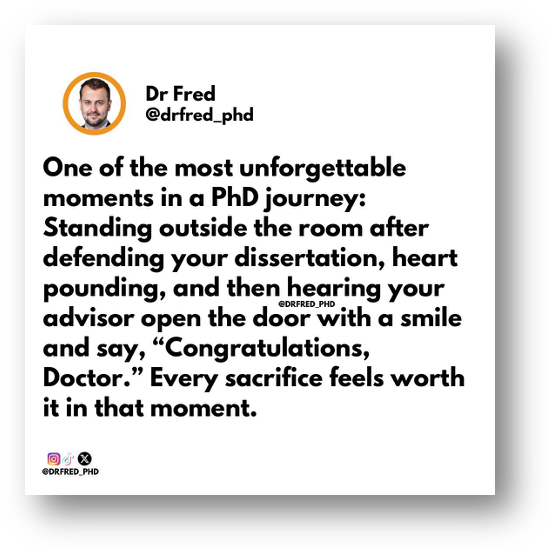
Overall, your PhD is a deeply personal journey, and you get to design it. Many things will be out of your control, but for most of us, the journey is what we make it. So choose to enjoy your PhD. Choose to balance work and life. Choose to make the best of an intense experience.
It’s okay. You’re allowed to.
Hope you enjoyed that!
If you did, why don’t you check out Ome’s TikTok?
For full subscribers, some resources for doctoral researchers and their supervisors.
And, of course, hopefully some of the resources on History in Organizations are helpful, too.

Managing your Research Career – Where to Start?

After last week’s free post, I thought I would create a bit of a list and resource of which Friday posts are now available for free.
The Newly Published Researcher’s Toolkit

We spend a lot of time counselling people on how to get published. We commiserate with the difficulties of getting published (it never gets old; new outrages occur every day). We talk about publishing strategy and the many tools and tricks to get organised, stay motivated, and avoid procrastination.
Hope this helps!