

Managing your Research Career – Where to Start?
On value chains, ikigai, and why you don’t actually manage time

After last week’s free post, I thought I would create a bit of a list and resource of which Friday posts are now available for free.
Catch-up service:
The Guide to Historical Methods in Management, of course
Is AI taking over Social Science Part 1 (Part 2 is mostly free as well)
Rohin’s great talk about his Organization Science article
Paula’s excellent post on research dissemination, also mentioned below.
There’s more, but I am running out of time and will provide a full list soon.
I teach strategy, so I have taught the value chain and related frameworks to students for years. When I was still an early-career scholar, I found myself in a position that many doctoral students might recognise: so many things seemed possible, and it was genuinely difficult to know what to do first or how much time to give to any of it.
At some point, I decided to try one of the strategy models I teach and apply it to my activities and career. So I asked myself: What does a value chain look like for an individual?
It turned out to be quite a fun exercise (yes, really). Not because the result was perfect, but because it forced me to look at the pieces, think about how they fit together, and be honest about the trade-offs. I have a tendency to say yes to everything, and it helped me see why that was not working.
This post grew out of the BAM Doctoral Fridays session in May 2026, on managing the doctoral journey. BAM Doctoral Fridays are a British Academy of Management initiative for doctoral researchers.
This is what I talked about at the BAM Doctoral Fridays session last week. One of these things I like to say yes to. And, actually, rarely regret.
The value chain of a researcher
Porter’s value chain is a tool for understanding how an organisation creates value: what comes in, what gets processed, what gets delivered to market, and what support functions underpin it all. It was designed for firms. Turns out it works okay for academic careers, which is either reassuring or alarming, depending on your disposition.
My version looks roughly like this: On the research side — inbound resources (reading, data, ideas, networks), operations (writing articles, preparing grant applications), and delivery (submitting, navigating peer review, publication). Teaching sits alongside this as a parallel track: preparation, delivery, assessment. And then the key element at the end, which is frequently overlooked: visibility. Which is something that most of us ignore – but if you spent a lot of time and effort on creating the best work possible, you want it to be visible in your community, sure?
Self-promotion always seemed to be more warmly embraced by our American colleagues (sorry guys), at least that was my impression during the PhD, so many years ago. These days, social media has changed the playing field. Paula de la Cruz-Fernandez and I are planning a small, affordable e-Book that brings together blogs and broader practice in dissemination as a guide. And in the meantime, LinkedIn has emerged as the academic marketplace of ideas that some say Twitter once was (I was not so involved in social media at the time).

But back to the value chain exercise. What are the equivalent support functions for an academic career? Procurement means finding opportunities, securing funding and securing protected time within your institution. Continuous development means investing in your knowledge of literature, identifying training opportunities and expanding your skills. Building your infrastructure: reference management, databases, AI tools, whatever your digital setup looks like – and if you need help with that, check out the “Tech Stack” section on this blog.
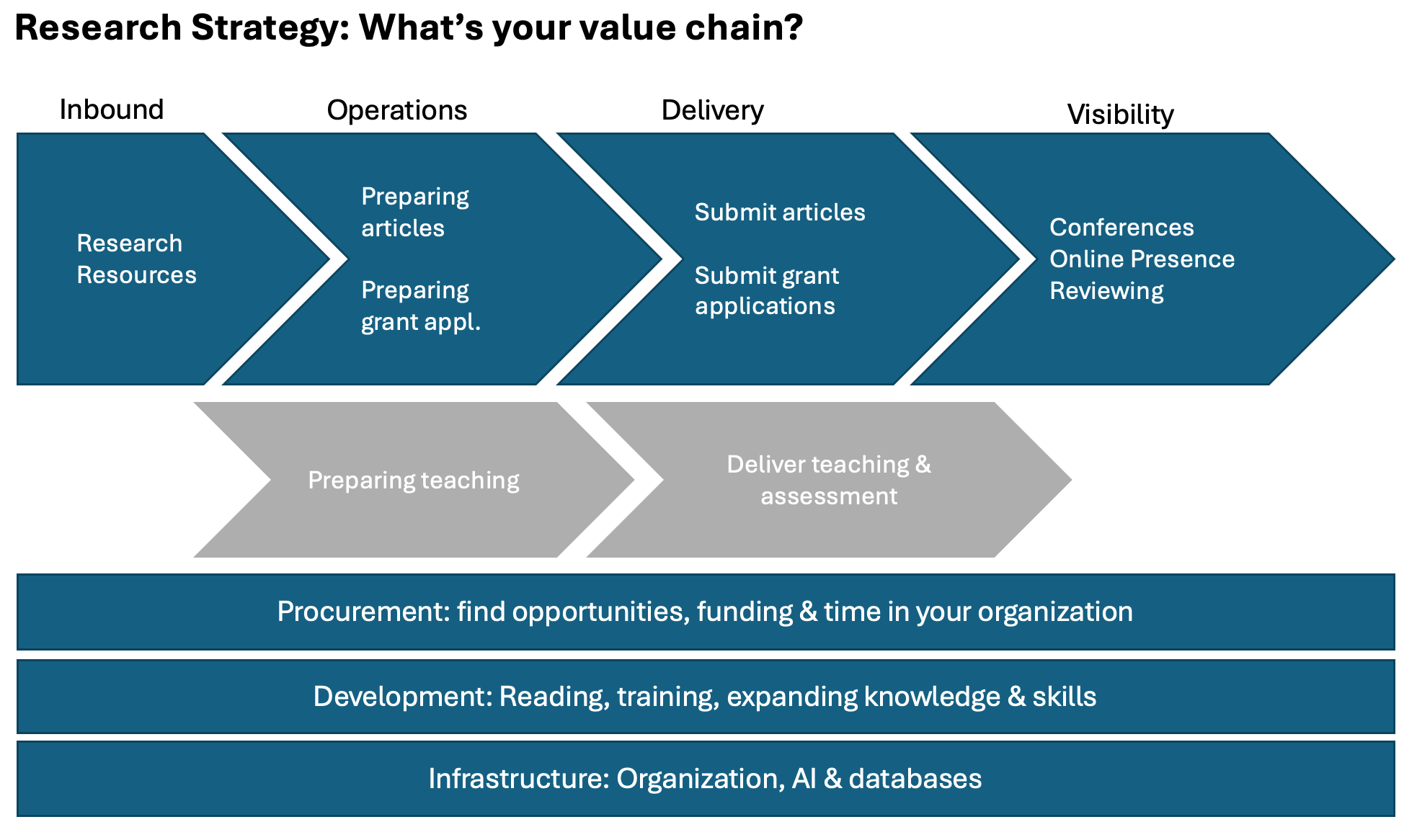
Doing this exercise was a useful audit that made me feel more confident about balancing the different demands and opportunities in an academic career. Yours might look different; that’s kind of the point with these diagnostic business models. I immediately noticed that I was putting almost no energy into visibility — the part where people actually discover your work. Conferences, LinkedIn, Google Scholar, ResearchGate, a blog. As you can see, I have now taken care of these, and I even blogged about your essential and optional to-dos. Also worthwhile drawing on Anne-Wil Harzing’s resources; her blog and YouTube channel are worth checking out if this is not something you have already sorted out.
The other thing the exercise clarifies is trade-offs. A primarily research-focused academic will have a very different value chain from a teacher-scholar. But ultimately, all of us have kind of portfolio careers, which means facing a wide range of choices that need to be balanced.
The ikigai of scholarly publishing
There is a Japanese concept, ikigai — roughly “life value” or “a sense of purpose.” In its popular form, it describes the overlap of four things: what you love, what the world needs, what you are good at, and what you can be paid for. You have probably seen the diagram. It’s cute, and a good way to dig a little deeper into what motivates you. And there is no part of an academic career where you need to be more motivated than scholarly publishing. Sadly.
For scholarly publishing, I think the four circles should be: what you love to write about, what the world needs to read, what gets recognised by your peers, and what gets published in the journals that count in your field.
The overlaps are perhaps more interesting:
Editors of prestigious journals will tell you they publish what the world needs. Read a few issues of any of them and form your own view on that.
What you love to write and what your peers recognise sometimes coincide – but often not, and the gap can feel like a personal failing when it is actually a structural feature of the field.
The full four-way overlap – the thing you love, that matters, that is recognised, and that high-status journals will publish – does exist. It just tends to belong to a fairly small number of people at the top of the distribution.
Most of the time, you are navigating trade-offs between these four things. Knowing where you are willing to make these trade-offs should be a central part of your research strategy. And if a research career does not actually appeal once you think it through clearly, that is important information too. Maybe teaching, or more impact-oriented work with practitioners, or indeed management, is what you end up finding more appealing. That is fine. Strategy is mostly about what you are NOT going to do.
After the paywall, we look at practical ways to manage your time (which is not actually possible, more on that later), some systems that I found to work well, and some resources that help you figure out what might work for you.
Also, the usual collated list of reading suggestions from media and blogosphere, and a completely gratuitous picture of a lovely Venetian craft shop (that you should totally visit if you are there) if you scroll all the way to the bottom :-)
